

Reverse Holo vs Holo Pokémon Cards: How to Tell Them Apart
By TCG Vault Team · · 7 min read
Written by the team that builds TCG Vault — how we research these guides.
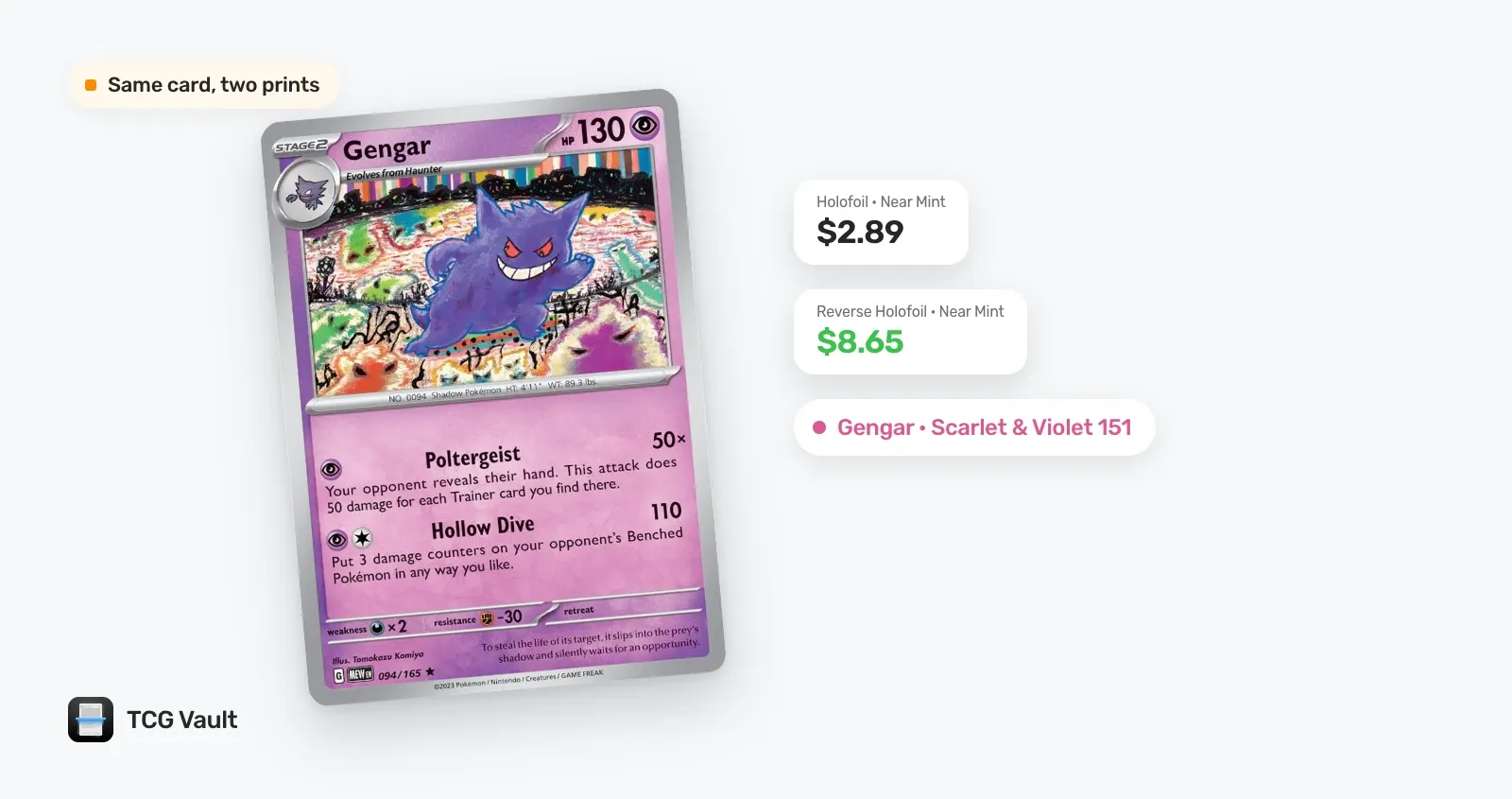
Reverse holo vs holo is easy to learn: the two look completely different once you know where to look. And the difference matters: the same card can be worth a few cents or a few hundred dollars depending on its printing.
Below, we explain how to tell them apart and compare the prices of both printings for thousands of cards in the TCG Vault database, using TCGplayer market prices for Near Mint copies on September 19, 2026.
Holofoil vs reverse holofoil: what’s the difference?
Bulbapedia, the community Pokémon encyclopedia, defines holofoil cards as having “a shiny, light-scattering holofoil effect on the card’s artwork or background.” A reverse holofoil “usually has the effect applied to the entire card apart from the picture.”
In other words, they’re opposites:
| Holo (holofoil) | Reverse holo (reverse holofoil) | Regular (non-holo) | |
|---|---|---|---|
| Where the foil is | In the artwork window | Everywhere except the artwork | Nowhere |
| Which cards have it | Holo rares; in current sets, rares, ex cards and everything rarer | Most commons, uncommons and rares have a reverse version | Commons and uncommons |
| First appeared | Base Set, 1999 | Legendary Collection, 2002 | Base Set, 1999 |
| How many per pack | Depends on the set’s rarity slots | One per pack from Legendary Collection; two per pack since Scarlet & Violet | The rest of the pack |
| Typical price vs regular | Varies by rarity | About 2.7 times the regular version (median) | Baseline |
The pack counts come from Bulbapedia; the price comparison comes from our data, explained below.
How to tell a holo from a reverse holo
Hold the card under a light and tilt it. Then check two places:
- The artwork window. If the picture shimmers and the rest of the card is flat, it’s a holo.
- The border, text box and background. If those shimmer and the picture is flat, it’s a reverse holo.
If nothing shimmers, it’s a regular (non-holo) card. And if the entire card, artwork included, is covered in foil or texture, you’re probably holding a full art, an Illustration Rare or another higher rarity rather than either of the two.
Reverse holo patterns also change from set to set. Legendary Collection used a fireworks pattern, Prismatic Evolutions added Poké Ball and Master Ball versions, and Ascended Heroes has Energy Symbol and Friend Ball versions. If a pattern looks unfamiliar, it’s usually worth looking up, because special patterns are often priced as separate cards.
One modern wrinkle: in Scarlet & Violet and Mega Evolution sets, rare cards are printed as holos by default and also come in a reverse holo version. So a rare can exist as two different shiny cards. In our catalog of those sets, 429 rare cards have a holo printing and 397 have a reverse holo printing.
Reverse holo vs holo: which is worth more?
We compared the two printings of the same card wherever both have a current market price. There are two comparisons that matter:
- Reverse holo vs regular: 11,166 cards have both a regular and a reverse holo printing. The reverse holo is worth more 98.7% of the time, at a median of 2.72 times the price.
- Reverse holo vs holo: 1,628 cards have both a holo and a reverse holo printing. The reverse holo is worth more 72.7% of the time, at a median of 1.24 times the price.
The pattern changes a lot by era:
| Set release years | Reverse beats regular | Median reverse ÷ regular | Reverse beats holo | Median reverse ÷ holo |
|---|---|---|---|---|
| 1999–2003 | 98.4% | 5.87× | 38.7% | 0.79× |
| 2004–2006 | 99.3% | 14.27× | 78.3% | 1.45× |
| 2007–2010 | 99.0% | 5.27× | 37.9% | 0.87× |
| 2011–2016 | 99.4% | 2.92× | 75.7% | 1.26× |
| 2017–2019 | 99.4% | 2.13× | 72.4% | 1.15× |
| 2020–2022 | 97.8% | 2.03× | 82.6% | 1.24× |
| 2023–2026 | 97.7% | 1.88× | 92.2% | 1.44× |
Two takeaways. Against the regular version, the reverse holo almost always wins, and by the widest margin in 2004–2006 sets, where the median reverse holo is worth about 14 times its regular twin. Against the holo, it depends: in 1999–2003 and 2007–2010 sets the holo usually wins, while in modern sets the reverse holo is worth more nine times out of ten.
Keep the scale in mind for modern cards, though. In 2023–2026 sets, the median rare holo is $0.19 and its reverse holo $0.27. The reverse holo wins, by eight cents.
Why are reverse holos worth more than regular cards?
Mostly because there are fewer of each one. According to Bulbapedia, packs have carried one reverse holo since Legendary Collection and two since Scarlet & Violet, and those one or two slots are shared across nearly every common, uncommon and rare in the set. The rest of the pack is mostly regular cards. So any particular card’s reverse holo tends to turn up less often than its regular version.
Demand adds to it. Master set collectors need every printing of every card, reverse holos included. Put scarcer supply together with steady demand and the reverse holo ends up with the higher price almost every time.
That premium is modest for ordinary modern cards, where both versions are worth cents. It becomes serious for popular Pokémon and for older sets, as the examples below show.
When is the holo worth more than the reverse holo?
Mostly in older sets. These are some of the widest gaps in our data where the holo comes out ahead:
| Card | Set (year) | Holo | Reverse holo |
|---|---|---|---|
| Rayquaza 20/95 | Call of Legends (2011) | $1,013.27 | $303.32 |
| Dragonite 9/165 | Expedition (2002) | $799.69 | $599.75 |
| Mew 19/165 | Expedition (2002) | $500.00 | $216.30 |
| Glaceon 5/100 | Majestic Dawn (2008) | $357.85 | $139.99 |
| Team Aqua’s Kyogre 3/95 | EX Team Magma vs Team Aqua (2004) | $316.30 | $70.21 |
There’s no single rule, which is why it’s worth checking both printings of any older card before you price it.
Which reverse holos are worth the most?
The first reverse holos are the headline. Legendary Collection (2002) introduced reverse holofoil prints, and Bulbapedia notes its reverse holos have “a fireworks-like pattern.” Those fireworks cards now sell for far more than the holos:
| Card (Legendary Collection) | Regular or holo | Reverse holo |
|---|---|---|
| Gengar 11/110 | $289.99 (holo) | $1,799.99 |
| Pikachu 86/110 | $6.34 (regular) | $1,574.99 |
| Charizard 3/110 | $899.99 (holo) | $1,399.31 |
| Articuno 2/110 | $69.99 (holo) | $749.99 |
Yes, that’s a common Pikachu worth $6.34 in its regular printing and $1,574.99 as a reverse holo. Reverse holos of popular Pokémon from modern sets also carry a premium, just a smaller one: in Scarlet & Violet 151, Gengar is $2.89 as a holo and $8.65 as a reverse holo, and Snorlax is $0.32 regular and $5.37 reverse holo.
What about Poké Ball and Master Ball reverse holos?
Some recent sets add extra reverse holo versions with special patterns, and TCGplayer lists each one as its own product. Prismatic Evolutions is the clearest example:
| Card (Prismatic Evolutions) | Regular or holo | Reverse holo | Poké Ball pattern | Master Ball pattern |
|---|---|---|---|---|
| Umbreon 059/131 (rare) | $0.49 (holo) | $0.55 | $3.98 | $77.83 |
| Eevee 074/131 (common) | $0.22 (regular) | $0.30 | $1.66 | $17.32 |
The Master Ball pattern Umbreon is worth about 140 times the regular reverse holo of the same card. In Prismatic Evolutions, every common, uncommon and rare has a Poké Ball pattern version, but only the Pokémon cards also get a Master Ball version. Black Bolt and White Flare also have Master Ball pattern versions. Black Bolt’s Maractus, a common, is $0.20 as a plain reverse holo and $27.19 with the Master Ball pattern. Ascended Heroes uses patterns too: its Pikachu common is $0.28 in the regular printing, $0.66 with the Energy Symbol pattern and $0.84 with the Friend Ball pattern.
If a reverse holo has an unusual pattern, look it up separately. It may be a different product with a very different price.
How to check what your holo or reverse holo is worth
- Identify the card. Name, set and collector number, printed at the bottom.
- Identify the printing. Regular, holo, reverse holo, or a special pattern.
- Look up the matching price. Scan the card with TCG Vault to identify it and see its TCGplayer market price, or search it in our free Pokémon card value checker. Whichever you use, make sure the price you compare belongs to the same printing.
For more on which printings and rarities carry real value, see our guides to what Pokémon cards are worth money and whether Pokémon cards are worth anything.
Frequently asked questions
Is a reverse holo the same as a full art?

No. A full-art card's artwork covers the whole card. A reverse holo keeps the normal card layout, with foil on everything except the artwork window.
Do ex and full-art cards have reverse holo versions?
In current sets, almost never. In our Scarlet & Violet and Mega Evolution data, reverse holo versions exist for commons, uncommons and rares, while ex cards and higher rarities are listed as holofoil only, with a couple of exceptions.
What is a cosmos holo?
Cosmos holo is a separate holo pattern used on many promo, blister-pack and prize cards. TCGplayer lists cosmos holo versions as their own products, so check that you're pricing the right one.
Why is my reverse holo worth less than the holo version?
In some older sets the holo is the more sought-after version. In our data, reverse holos from 1999–2003 sets are worth more than the holo version only 38.7% of the time.
Can one card be both holo and reverse holo?
No. Some cards were printed in both a holo version and a reverse holo version, but each physical card is one or the other.
Keep reading
-
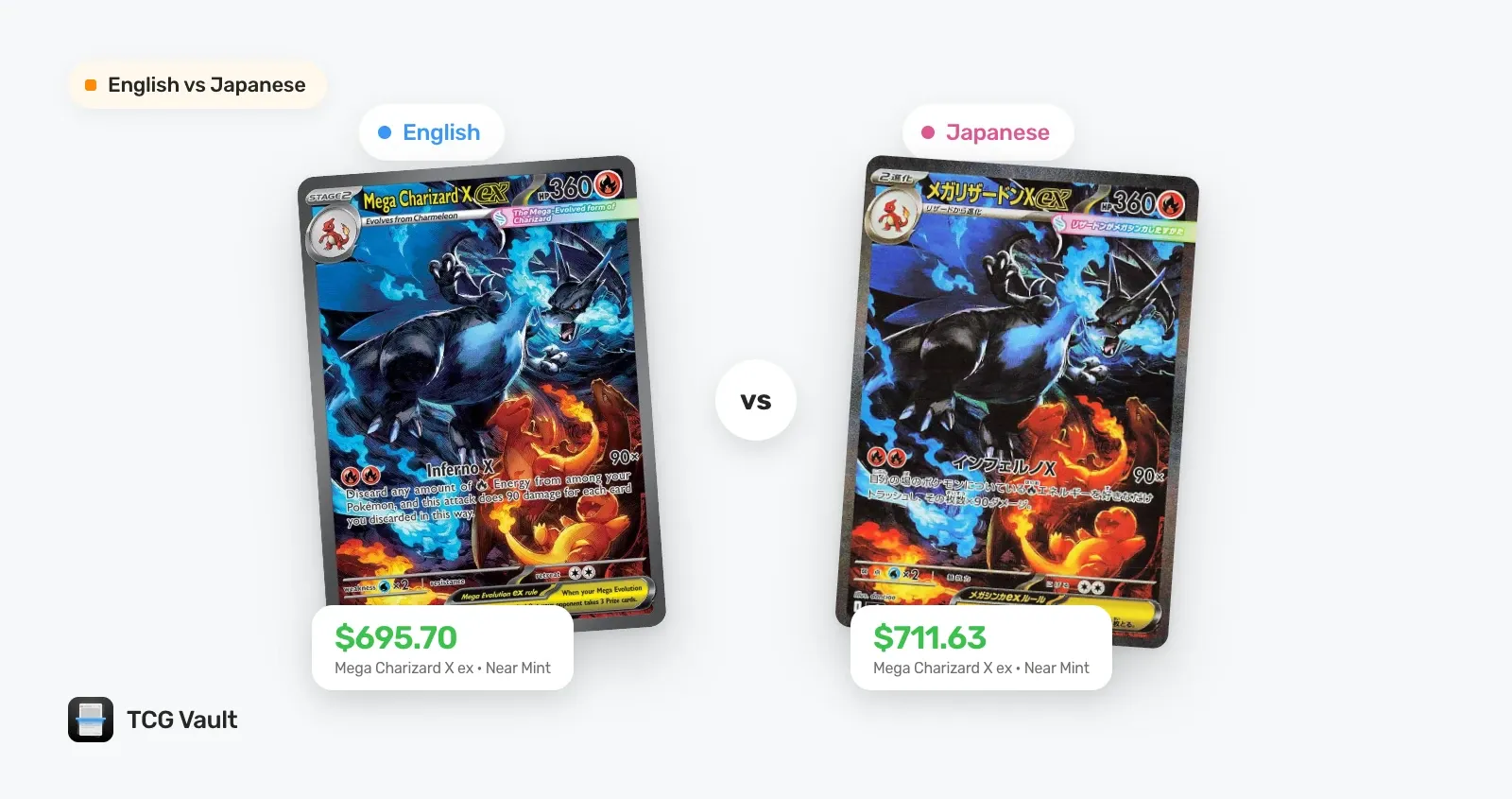
Are Japanese Pokémon Cards Worth More?
Usually not in the US. English copies cost more for 4 in 5 chase cards we matched in September 2026 TCGplayer data. When Japanese cards win, and why.
-
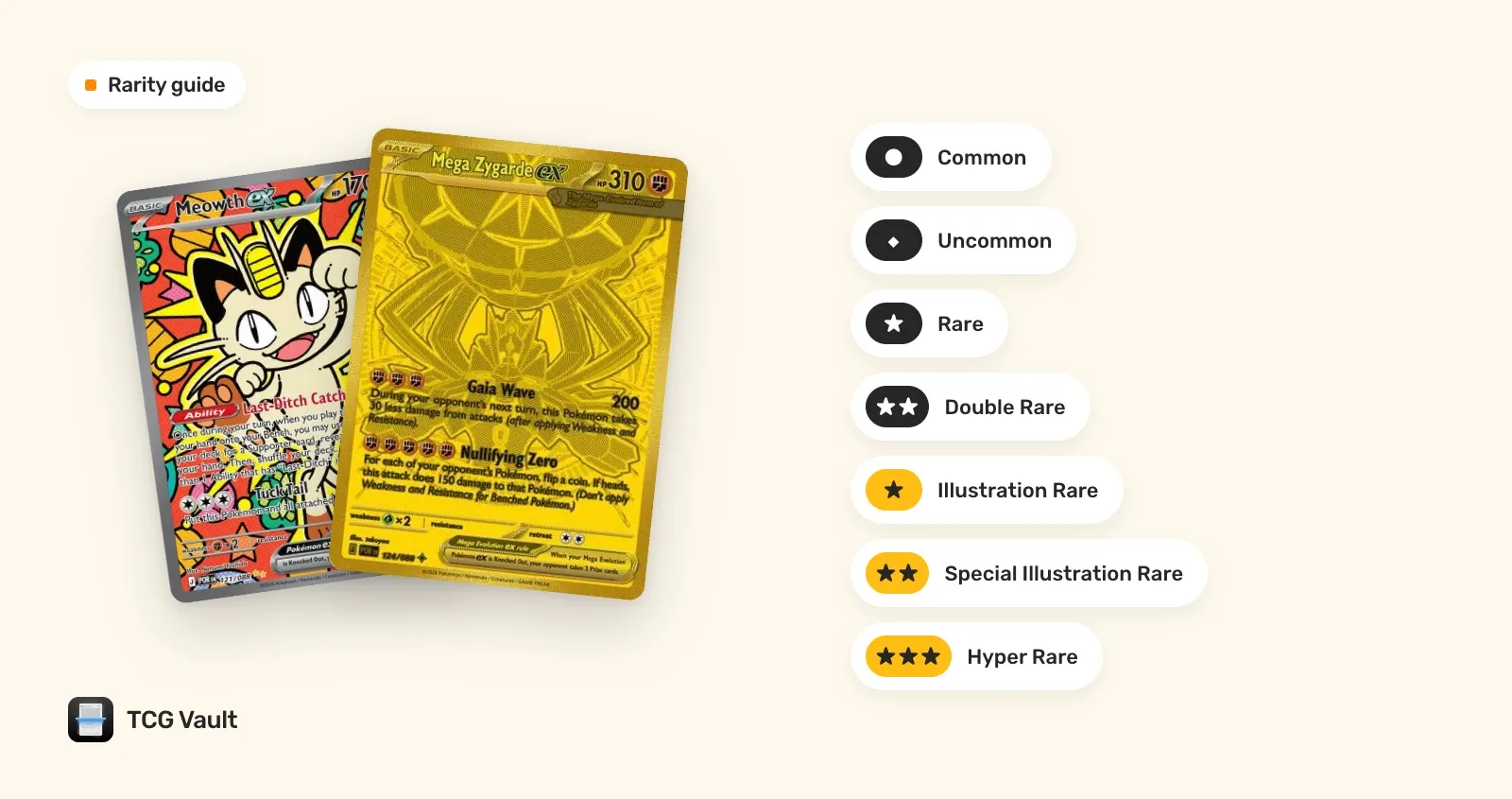
Pokémon Card Rarity Symbols Explained
The rarity symbol sits next to the card number: circle is common, diamond uncommon, star rare. Every modern star symbol explained, with real price data.



See what your cards are really worth.
Scan a card with your iPhone and TCG Vault shows its market price in seconds — then keeps your whole collection’s value up to date.
 Download on iOS
4.5★ from 107 App Store ratings
Still choosing? See 9 card scanner apps compared →