

Are Pokémon Cards Worth Anything? An Honest Answer With Real Prices
By TCG Vault Team · · 7 min read
Written by the team that builds TCG Vault — how we research these guides.
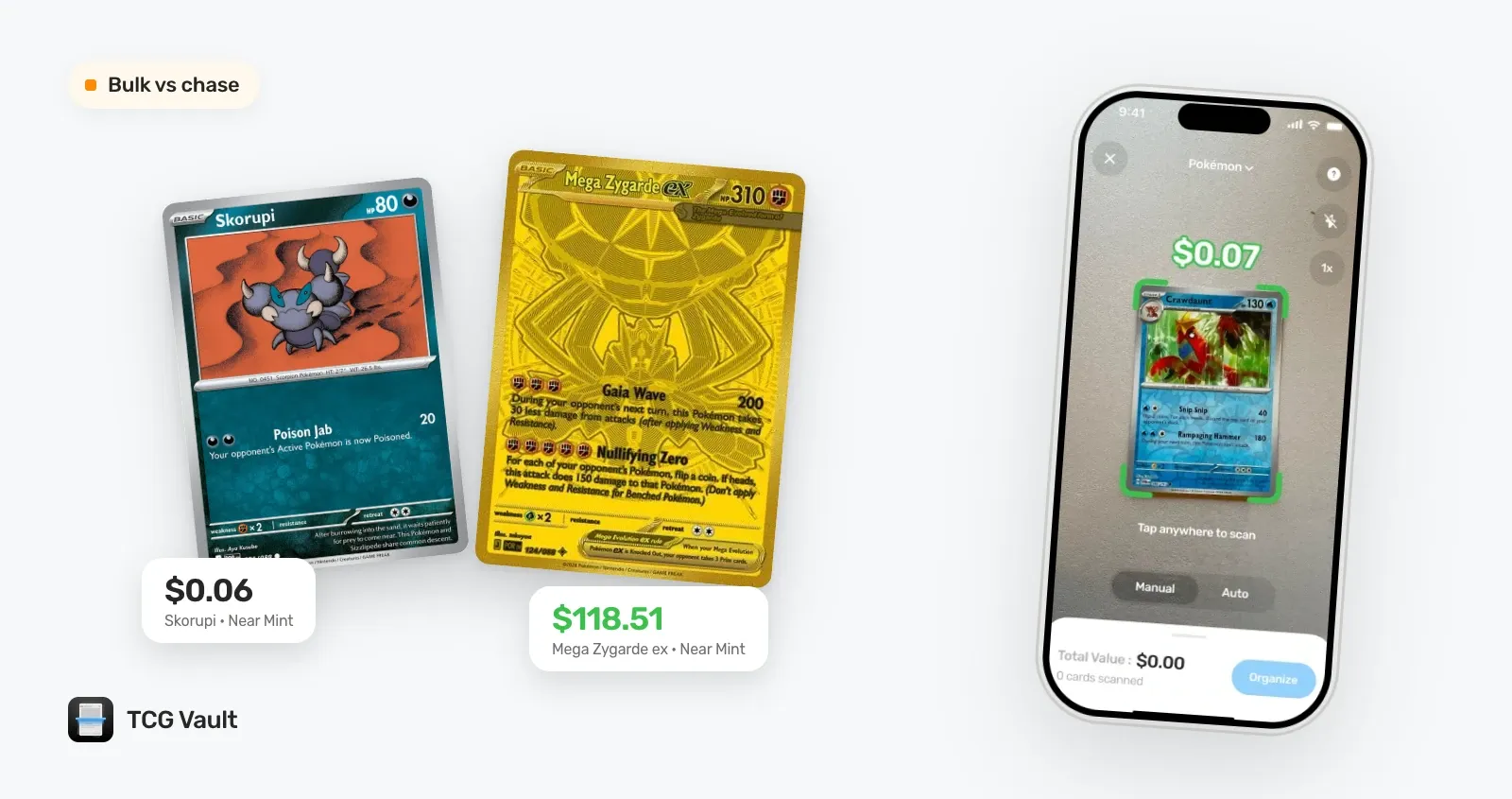
Are Pokémon cards worth anything? If you’ve just found an old binder or opened your first box of packs, it’s the obvious question. The honest answer is that most cards are worth cents, a few are worth a lot, and it’s easy to tell which is which once you know the pattern.
We checked every English Pokémon card version in the TCG Vault database with a current TCGplayer market price, 42,091 in total, using Near Mint prices as of September 19, 2026. Here’s what they’re worth.
Are Pokémon cards worth anything? The short answer
Half of all English Pokémon card versions sell for under $1. For recent sets, it’s closer to four in five.
| Market price, Sep 19, 2026 | All English card versions | Scarlet & Violet and Mega Evolution sets (2023–2026) |
|---|---|---|
| Under $1 | 49.3% | 78.7% |
| $1 to $5 | 20.1% | 8.9% |
| $5 to $20 | 15.0% | 7.7% |
| $20 to $100 | 11.5% | 3.9% |
| $100 to $1,000 | 4.0% | 0.8% |
| $1,000 or more | 0.1% | 1 card |
| Median | $1.04 | $0.24 |
The whole-catalog column looks better because it includes decades of older cards, which are worth more on average. The recent-set column is what a typical pack opener actually owns.
So if your cards are mostly recent commons and uncommons, they’re worth a few cents each. But the tail on the right is long: about 1 in 25 English card versions is worth $100 or more.
How much are Pokémon cards worth by rarity?
Rarity is the fastest way to estimate what a modern card is worth. These are median market prices across the 22 Scarlet & Violet and Mega Evolution sets:
| Card type | Median market price |
|---|---|
| Common, regular | $0.13 |
| Uncommon, regular | $0.13 |
| Common, reverse holo | $0.22 |
| Rare, holo | $0.21 |
| Double Rare (regular ex cards) | $0.80 |
| Ultra Rare (full-art ex and Trainers) | $2.22 |
| Illustration Rare | $12.16 |
| Special Illustration Rare | $34.88 |
| Mega Hyper Rare | $207.04 |
The rarity symbol at the bottom of the card, and whether the card is full art or textured, tells you most of what you need. Anything from a Double Rare down is bulk unless it features a very popular Pokémon.
Why are most Pokémon cards worth so little?
Supply. The Pokémon Company says it had produced more than 85 billion cards by the end of March 2026. Every booster pack holds 10 cards, and more than half of a typical set’s card list is commons and uncommons (68 of the 124 numbered cards in Perfect Order, for example). Those cards exist in enormous numbers, so there’s always more supply than demand.
Demand, meanwhile, is concentrated. Collectors chase the handful of art-focused rarities in each set, and players need a limited number of competitive cards. Everything else sits in bulk boxes. That isn’t a flaw in your collection; it’s normal for every modern set.
Which Pokémon cards are worth something?
A small number of patterns explain almost every valuable card.
Top rarities of popular Pokémon
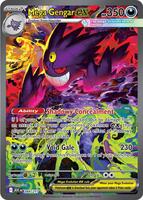
The Pokémon on the card matters as much as the rarity. Among 222 Special Illustration Rares from recent sets, the 23 featuring long-time favorites such as Pikachu, Charizard, Umbreon, Gengar and Mew have a median price of $315.57. The other 199 have a median of $30.76.
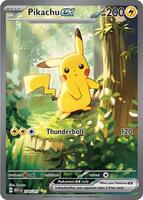
The same Pokémon can be bulk or a centerpiece depending on the version. In Ascended Heroes, the regular Pikachu ex (a Double Rare) sells for $2.92, while its Special Illustration Rare, 276/217, is at $954.38.
Special pattern versions
Some sets print extra versions of ordinary cards with special reverse holo patterns, and collectors pay for them. In Prismatic Evolutions, Eevee’s regular common is $0.22 and its reverse holo $0.30, but its Poké Ball pattern version is $1.66 and its Master Ball pattern version $17.32. Same card, nearly eighty times the price.
Black Bolt and White Flare work the same way. Their most expensive Master Ball pattern commons and uncommons sell for roughly $19 to $27 each, while the priciest ordinary common from any recent set, a Slowpoke reverse holo from Stellar Crown, is $6.81. If you see a Poké Ball or Master Ball pattern in your pile, set it aside.
Promos with a story
Most promos are worth a few dollars, but special ones break out. The Van Gogh Museum’s Pikachu with Grey Felt Hat promo is at $1,081.11, and staff-stamped prerelease promos can run into four figures.
For a full list of what to look for, see our guide to what Pokémon cards are worth money.
Are old Pokémon cards worth anything?
Much more often than new ones. The older the set, the higher the typical price. Here are median prices for every expansion era, from Base Set to today:
| Era | Median card price | Under $1 | $100 or more |
|---|---|---|---|
| Wizards of the Coast (1999–2003) | $13.90 | 7.8% | 15.3% |
| EX series (2003–2007) | $14.75 | 12.7% | 11.2% |
| Diamond & Pearl and Platinum (2007–2009) | $3.54 | 24.4% | 2.8% |
| HeartGold & SoulSilver (2010–2011) | $5.88 | 22.6% | 6.2% |
| Black & White (2011–2013) | $1.39 | 42.1% | 3.1% |
| XY (2014–2016) | $0.64 | 63.9% | 1.7% |
| Sun & Moon (2017–2019) | $0.54 | 63.7% | 2.2% |
| Sword & Shield (2020–2023) | $0.29 | 75.8% | 0.9% |
| Scarlet & Violet (2023–2025) | $0.24 | 77.2% | 0.6% |
| Mega Evolution (2025–2026) | $0.23 | 80.2% | 1.6% |
Two things stand out. Cards from 1999 to 2007 have a median above $13, so even their commons are often worth checking. And the 1st Edition stamp matters on everything: the median Base Set common is $0.88 in its unlimited version and $28.80 with a 1st Edition stamp.
Condition still decides the final number. A vintage card with creases, whitening or water damage sells for less than a Near Mint copy, though PSA points out that many vintage cards stay valuable even in low grades. If you have older holos in good shape, look them up before anything else in the box.
How to spot a potentially valuable card in seconds
You can sort most cards by eye before looking anything up. These signs mean a card deserves a closer look:
- A number higher than the set total, like 161/131. That’s a secret rare.
- Artwork that fills the whole card, often with a textured, etched surface. Full arts, Illustration Rares and Special Illustration Rares all look like this.
- Gold borders or gold-colored artwork on modern cards.
- A special pattern across the card, such as Poké Balls or Master Balls, in sets that use them.
- A stamp of any kind: 1st Edition, a prerelease or staff stamp, a championship logo.
- A star after the Pokémon’s name, the mark of the rare Pokémon Star cards from the EX era.
- An older card. Anything from 1999 to 2007 (Base Set through the EX series) is worth checking, even commons. The earliest cards carry a Wizards copyright line at the bottom.
Modern cards without any of these signs usually sell for under a dollar.
What should you do with a box of Pokémon cards?
You don’t need to look up thousands of cards one by one. Work through the box in this order:
- Pull out anything special. Holos, reverse holos, full arts, gold cards, textured cards and anything with a stamp or an unusual border.
- Check the era. Cards from 1999 to 2007 (Base Set through the EX series) deserve a closer look even if they’re commons.
- Look up the pile you pulled. Scan the cards with TCG Vault to see each one’s TCGplayer market price and add it to a collection with a running total. Or look cards up one at a time in our free Pokémon card value checker.
- Protect the keepers. Sleeve anything worth a few dollars, and put anything worth more in a top loader.
- Decide what to do with the rest. Keep it for playing or trading, give it to a younger collector, or sell it in bulk. Our guide on how to sell Pokémon cards explains where bulk sells and what to expect.
Most boxes turn out to be mostly bulk with a few cards worth keeping safe. Finding those few is the fun part.
Frequently asked questions
Are McDonald's Pokémon cards worth anything?

Usually a few dollars at most. Across all the McDonald's promo sets in our database the median card is $5.04, but the 2024 set's median is just $0.51.
Are damaged Pokémon cards worth anything?
Sometimes. PSA notes that many vintage cards are still very valuable even in a low grade, and TCGplayer lets sellers list cards as Damaged. A damaged modern common, though, is worth next to nothing.
Are reverse holo cards worth more than regular ones?
Usually a little. In our data, the reverse holo sells for more than the regular version of the same card 98.7% of the time, at a median of about 2.7 times the price.
Is it worth keeping bulk Pokémon cards?
Keep them if you play, trade or give cards to younger collectors. As an investment, a pile of commons is worth very little per card.
Do Pokémon cards go up in value?
Some do and many don't. Prices follow demand for each individual card, so there's no general rule, and nothing here is financial advice.
Keep reading
-
Are Japanese Pokémon Cards Worth More?
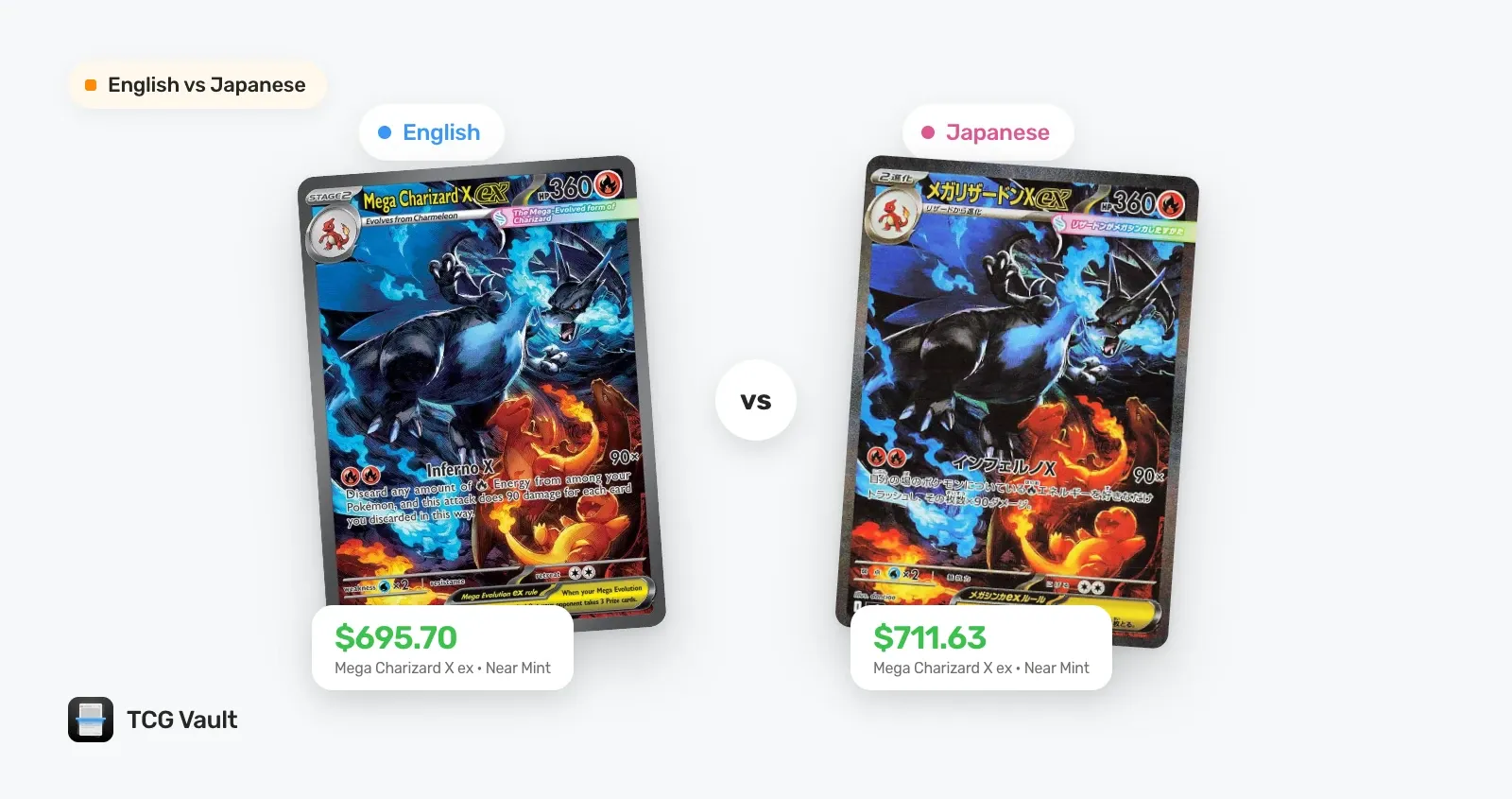
Usually not in the US. English copies cost more for 4 in 5 chase cards we matched in September 2026 TCGplayer data. When Japanese cards win, and why.
-
Pokémon Card Rarity Symbols Explained
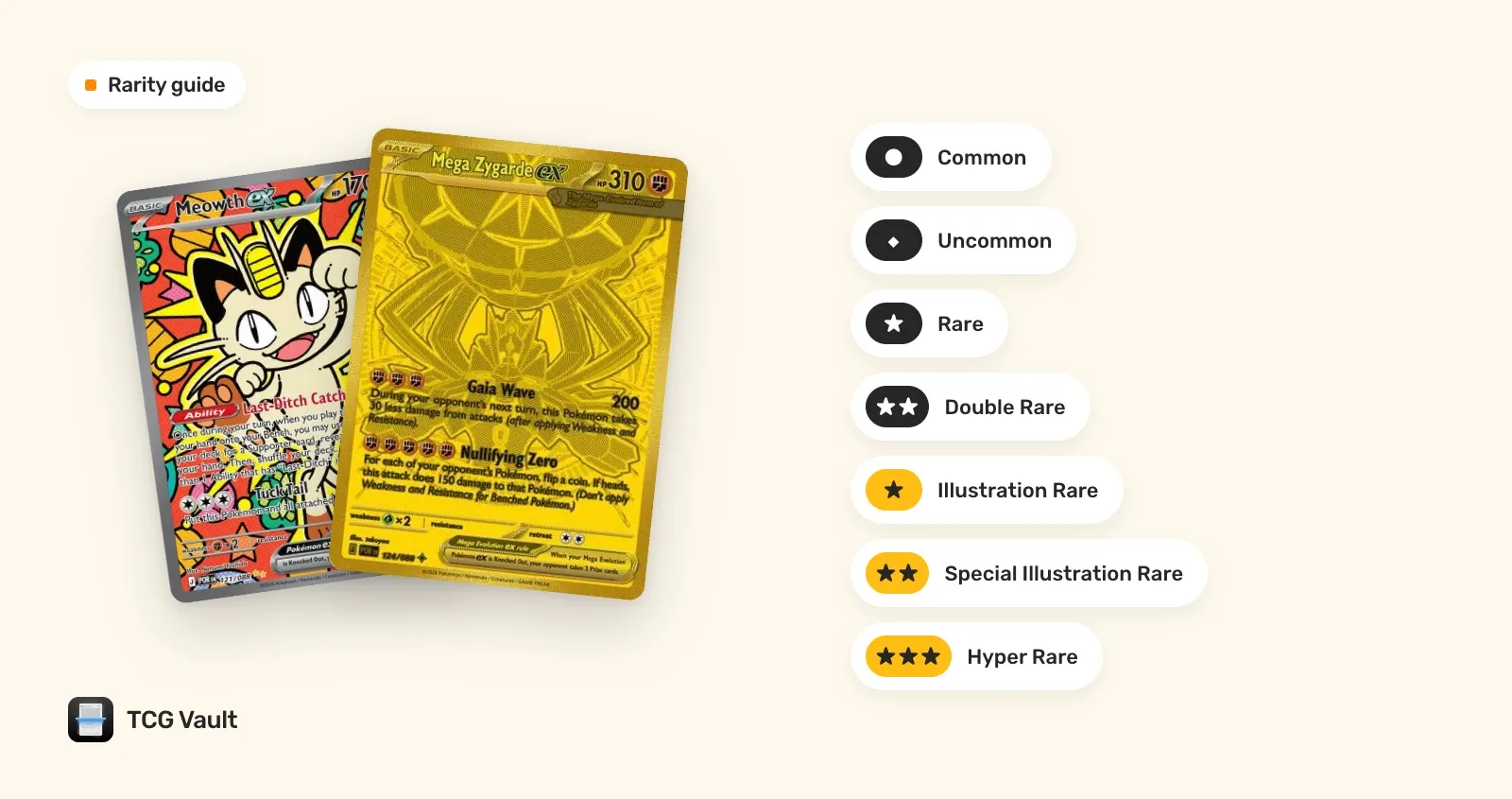
The rarity symbol sits next to the card number: circle is common, diamond uncommon, star rare. Every modern star symbol explained, with real price data.



See what your cards are really worth.
Scan a card with your iPhone and TCG Vault shows its market price in seconds — then keeps your whole collection’s value up to date.
 Download on iOS
4.5★ from 107 App Store ratings
Still choosing? See 9 card scanner apps compared →