

Pokémon Card Rarity Symbols Explained
By TCG Vault Team · · 7 min read
Written by the team that builds TCG Vault — how we research these guides.
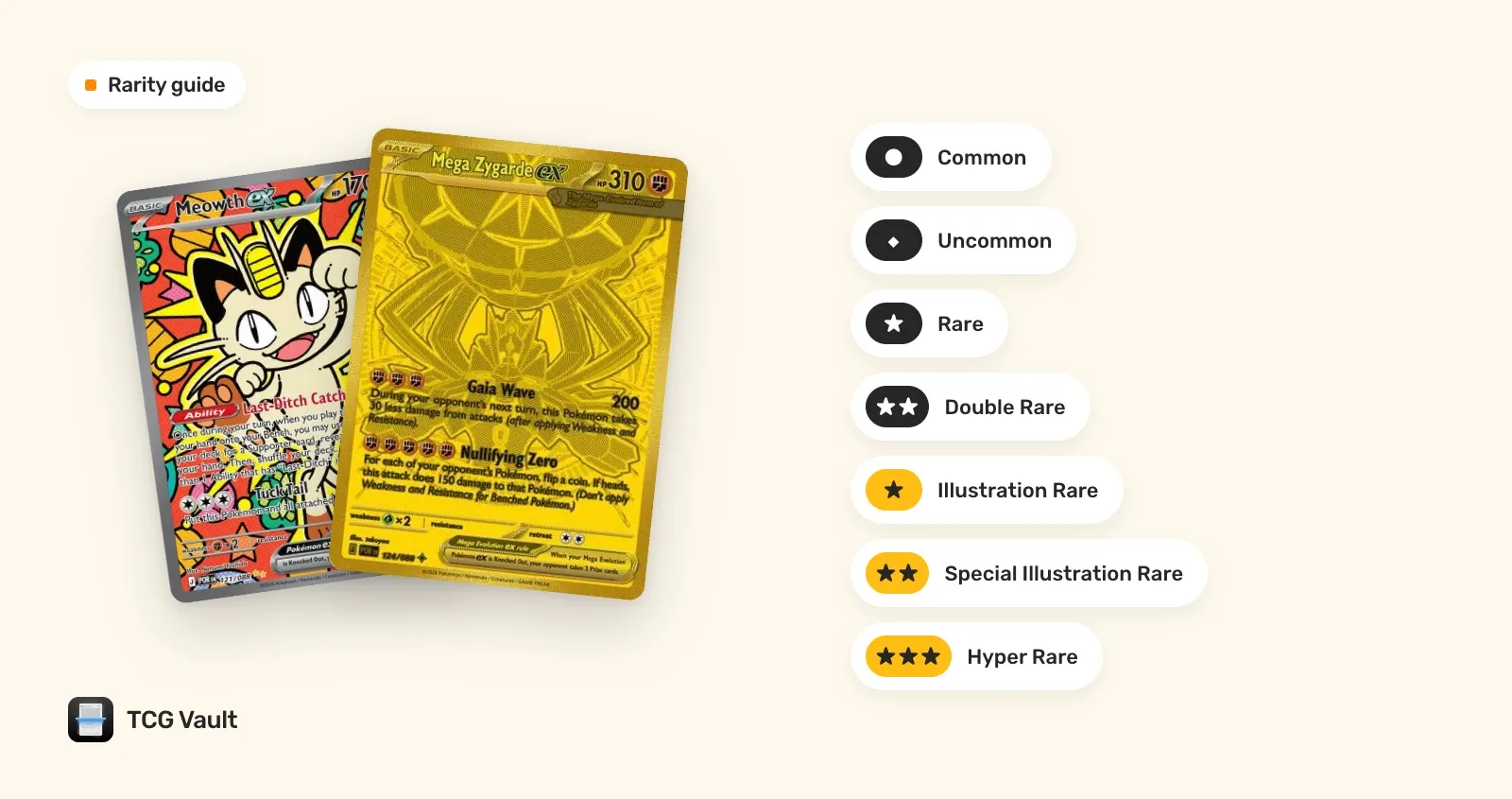
Pokémon rarity symbols tell you how hard a card was to pull from a pack. They’re easy to miss, since the symbol is only a few millimeters wide, and the list has grown a lot since the circle, diamond and star of 1999. This guide shows where to find the symbol, what every current symbol means, and what cards of each rarity actually sell for, using TCG Vault’s database of TCGplayer market prices.
Where is the rarity symbol on a Pokémon card?
On modern cards, look at the bottom left corner. Reading left to right, you’ll find the regulation mark (a letter in a box), the set code (such as PFL for Phantasmal Flames), the collector number (such as 125/094) and then the rarity symbol.
Older cards put it on the other side. The rarity symbol, set symbol and card number moved to the left with the Sun & Moon series in 2017. On cards printed before that, including the original 1999 Base Set, the symbol sits at the bottom right, right after the collector number.
Pokémon rarity symbols chart
Here’s every rarity symbol you’ll find on current English cards, with the median Near Mint TCGplayer market price of cards with that rarity in our database on September 18, 2026. The Scarlet & Violet column covers the 16 expansions from March 2023 to July 2025; the Mega Evolution column covers the five main sets from September 2025 to July 2026. Poké Ball and Master Ball pattern versions are left out.
| Symbol | Rarity | Median price, Scarlet & Violet sets | Median price, Mega Evolution sets |
|---|---|---|---|
| ● black circle | Common | $0.13 | $0.09 |
| ◆ black diamond | Uncommon | $0.14 | $0.10 |
| ★ one black star | Rare | $0.19 | $0.18 |
| ★★ two black stars | Double Rare | $0.81 | $0.68 |
| ★★ two silver stars | Ultra Rare | $2.24 | $2.32 |
| ★ one gold star | Illustration Rare | $14.60 | $2.92 |
| ★★ two gold stars | Special Illustration Rare | $29.74 | $44.59 |
| ★★★ three gold stars | Hyper Rare | $7.98 | Replaced |
| ✦ gold four-pointed star, black outline | Mega Hyper Rare | Not used | $173.47 |
| ★ pink star | ACE SPEC Rare | $0.60 | Not used |
| ☆ hollow gold star | Shiny Rare | $4.63 | $4.09 |
| ☆☆ two hollow gold stars | Shiny Ultra Rare | $2.23 | Not used |
| ★★ one black, one white star | Black White Rare | $592.58 | Not used |
| ★ black star with “PROMO” | Promo | Varies | Varies |
Two rarities belong to single sets so far. The Black White Rare exists only in Black Bolt and White Flare, four cards in all, and the Mega Attack Rare, covered below, appears only in Ascended Heroes.
What do the stars mean on Pokémon cards?
The circle, diamond and single black star go back to the first English set, Base Set, released on January 9, 1999, and the Pokémon Company kept them unchanged when it redesigned cards for Scarlet & Violet in 2023. Everything above Rare is a variation on the star, and the color tells you what kind of card it is:
- Black stars mark the regular rarities: one for Rare, two for Double Rare, which is the rarity of regular Pokémon ex cards.
- Silver (white) stars mark Ultra Rares, the full-art Pokémon ex and Supporter cards. On a white background they can be hard to see.
- Gold stars mark the art-focused and top-end cards: Illustration Rare, Special Illustration Rare and Hyper Rare.
- Hollow stars mark shiny Pokémon, as in Paldean Fates (January 2024).
- A pink star marks ACE SPEC cards, special Trainer and Energy cards limited to one per deck, which returned in Temporal Forces in March 2024.
Illustration Rare vs Special Illustration Rare vs Hyper Rare
All three arrived with the Scarlet & Violet base set on March 31, 2023.
- Illustration Rare (one gold star): a full-art Pokémon that isn’t a Pokémon ex, with artwork that fills the whole card. In the Scarlet & Violet sets, the median one was worth $14.60, and some are worth far more: Paldea Evolved’s Magikarp Illustration Rare was at $378.48.
- Special Illustration Rare (two gold stars): full-card artwork for a Pokémon ex or a Supporter. These are usually the most valuable cards in a set. The median was $29.74 in Scarlet & Violet sets and $44.59 in Mega Evolution sets, and the most valuable one in these sets, Prismatic Evolutions’ Umbreon ex, was at $1,410.28.
- Hyper Rare (three gold stars): a gold-colored version of a card. Pokémon notes that these were previously known as secret rares. Despite the extra star, the median Hyper Rare ($7.98) sold for less than the median Illustration Rare.
That last point is a good reminder: the number of stars describes rarity, not value.
What is a Mega Hyper Rare?
The Mega Hyper Rare replaced the Hyper Rare when the Mega Evolution series began with the Mega Evolution set on September 26, 2025. Its symbol is a four-pointed gold star with a black outline.
Mega Hyper Rares carry the highest median price of any rarity in the Mega Evolution sets: $173.47 across the five main sets. The most valuable in our data was Phantasmal Flames’ Mega Charizard X ex at $254.44.
Ascended Heroes (January 2026) added the Mega Attack Rare, marked with one pastel pink and one pastel green star; its median price there was $7.26. Before that set, English Mega Attack Rares had only appeared as black star promos.
What does the black star promo symbol mean?
Promo cards come from products, events and special releases instead of booster packs. Most carry a black star with the word “PROMO” instead of a normal rarity symbol. Current promos are numbered within their own promo set, such as SVP 001 for Scarlet & Violet or MEP 001 for Mega Evolution, and there’s no set total after the number.
Promo value varies a lot, and small details matter. In our data, the Meganium MEP 001 promo was at $29.19, while the same card with a “Staff” stamp was at $116.89.
Secret rares: when the number is higher than the set total
A card numbered above the set’s printed total, such as 199/165, is what collectors call a secret rare. It isn’t an official rarity with its own symbol; it’s a way of numbering the cards that sit beyond the main set list.
151 is a good example. Its cards are printed out of 165, but the set has 207 cards, so everything from 166/165 up is a secret rare. That’s where its Illustration Rares, Ultra Rares, Special Illustration Rares and Hyper Rares live, including the Charizard ex at 199/165.
Rarity symbols on older Pokémon cards
If you’re sorting cards from before 2023, you’ll meet a few symbols and marks that current sets no longer use:
- Rare Holo: the same single star as a Rare, but with foil artwork. It was the rarity above Rare from 1999 until the end of the Sword & Shield series in January 2023.
- 1st Edition stamp: marks cards from the first print run of a set, used from Base Set through Neo Destiny. It isn’t a rarity symbol, but it changes a card’s value.
- Shadowless: the second English print of Base Set, recognizable by the missing drop shadow around the artwork box.
- Amazing Rare: a rainbow “A” symbol, introduced in Vivid Voltage (2020).
- Radiant Rare: despite its special name, the card itself shows a plain white star.
Does the rarity symbol tell you what a card is worth?
Only roughly. Rarity tells you roughly how often a card turns up in packs, but the price depends on which Pokémon is on the card, how the artwork is received and how many people want it. TCGplayer’s own guide puts it bluntly: you can’t tell how valuable a card is just by identifying its rarity.
Our data backs that up. In the five main Mega Evolution sets, 71% of cards were worth less than $1 and every Common, Uncommon and Rare was under a dollar. But Special Illustration Rares ranged from about $14 to nearly $700 in the same sets.
So use the symbol to sort your cards, then check the price of the exact card. You can look it up by name and number with the Pokémon card value checker, or scan a whole stack with the TCG Vault card scanner, which shows each card’s rarity and current market price. For the difference between the foil patterns you’ll find on each rarity, see our guide to reverse holo vs holo cards.
Frequently asked questions
What does the letter in a box at the bottom of a Pokémon card mean?

That's the regulation mark, not a rarity. It tells you whether a card is legal in the Standard format. Since the 2026 rotation, which took effect for in-person play on April 10, 2026, cards marked G are no longer legal in Standard, while H, I and J cards are.
Why is the rarity symbol on my card white instead of black?
Some cards print the rarity symbol in white instead of black. The shape is what counts: a white circle still means Common, just like a black one.
Does a reverse holo have a different rarity symbol?
No. A reverse holo is a different printing of the same card, so it keeps the card's rarity symbol. What changes is the foil pattern, and with it the price.
How many Mega Hyper Rares are in a set?
Very few. In our card database, Phantasmal Flames, Perfect Order, Chaos Rising and Pitch Black each have one Mega Hyper Rare, while Mega Evolution and Ascended Heroes have two.
Do Japanese Pokémon cards use the same rarity symbols?
No. Since the Black & White era, Japanese cards print bold letters such as C, U, R and RR instead of symbols. On TCGplayer, the Japanese counterparts of Illustration Rare and Special Illustration Rare are listed as Art Rare and Special Art Rare.
Keep reading
-
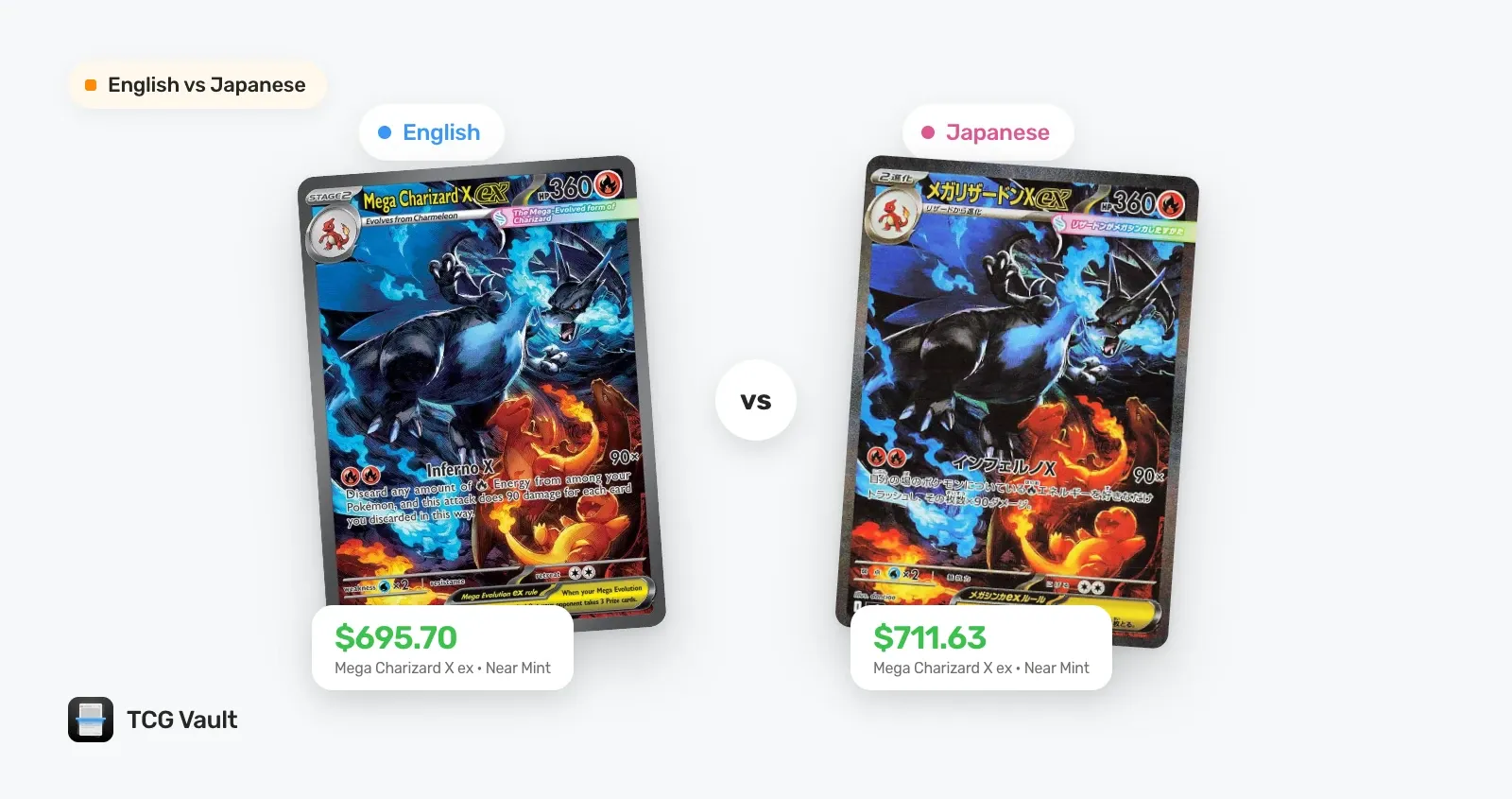
Are Japanese Pokémon Cards Worth More?
Usually not in the US. English copies cost more for 4 in 5 chase cards we matched in September 2026 TCGplayer data. When Japanese cards win, and why.
-
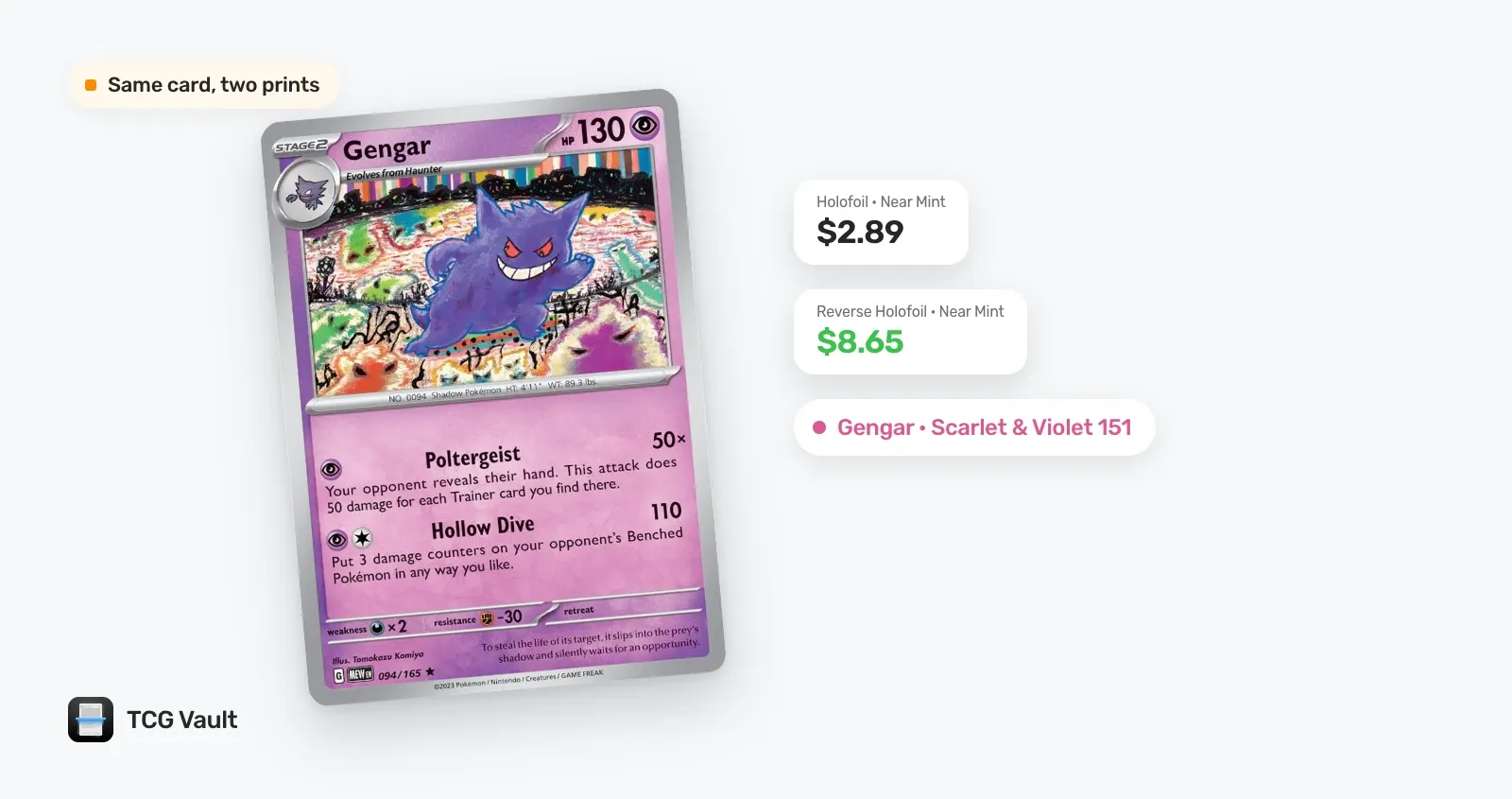
Reverse Holo vs Holo Pokémon Cards: How to Tell Them Apart
Reverse holo vs holo: a holo shines in the artwork, a reverse holo everywhere else. How to tell them apart and which is worth more, with real prices.






See what your cards are really worth.
Scan a card with your iPhone and TCG Vault shows its market price in seconds — then keeps your whole collection’s value up to date.
 Download on iOS
4.5★ from 107 App Store ratings
Still choosing? See 9 card scanner apps compared →