 Free download, track your collection

PSA Grading Scale Explained (1–10)
By TCG Vault Team · · · 9 min read
Written by the team that builds TCG Vault — how we research these guides.
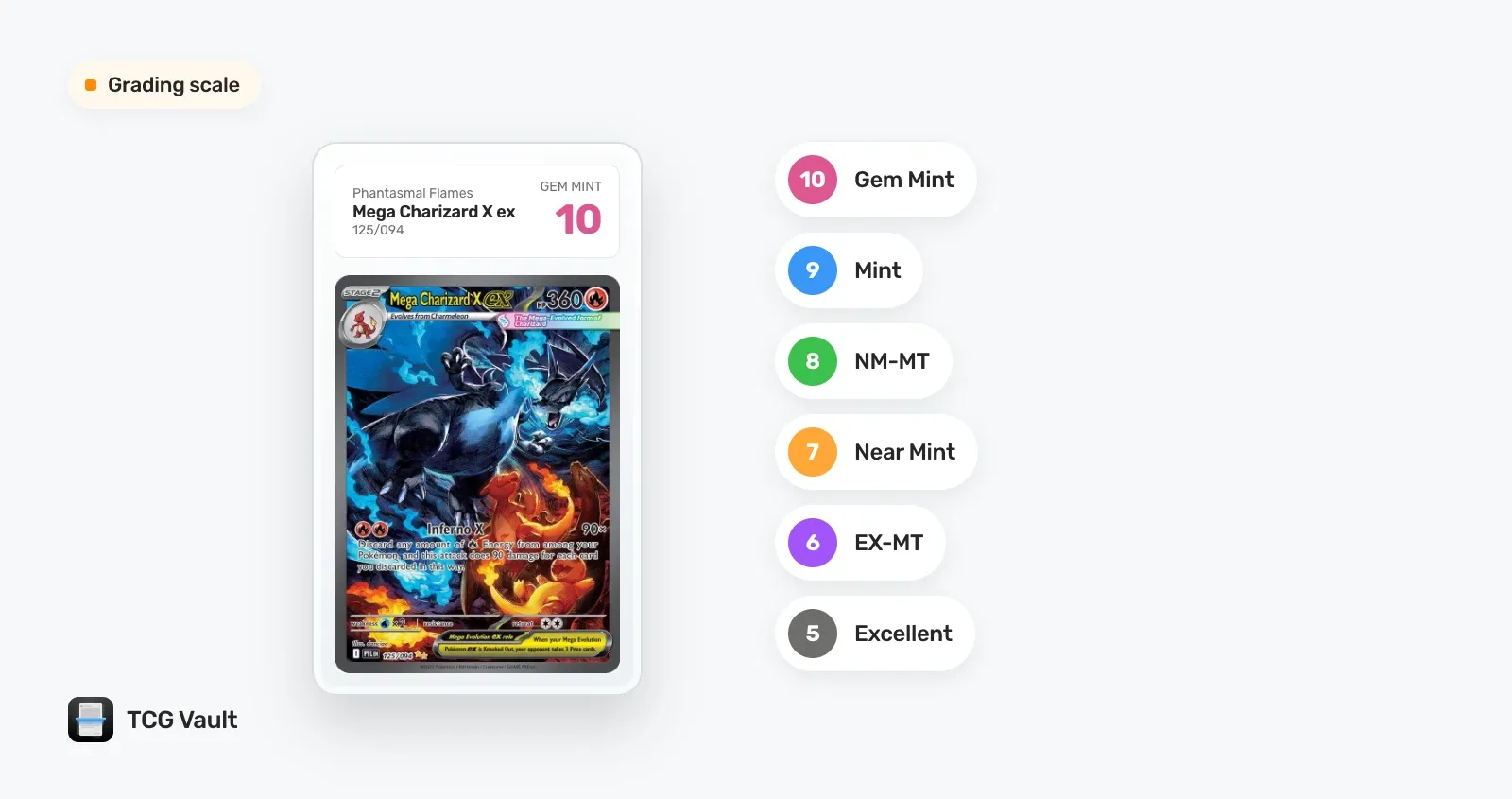
The PSA grading scale is the 10-point system Professional Sports Authenticator uses to describe a card’s condition. When someone calls a card “a PSA 10”, this is the scale they mean. A single number on a PSA label can change what a card sells for, so it pays to know exactly what each grade allows.
Everything below comes from PSA’s published grading standards, checked in September 2026, plus PSA’s own grading guide and pricing pages.
How does PSA grading work?
PSA grading happens in three steps. First, graders authenticate the card: they check that it’s genuine and look for doctoring such as trimming or recoloring. Only a card that passes gets graded. Second, graders assign a grade from 1 to 10 based on corners, edges, surface, focus, gloss, staining and centering. Third, the card is sealed in a tamper-evident case, and the grade and a certification number go on the label.
The grade is mostly objective. Graders measure centering and look for print defects, stains and surface wrinkles. But PSA is open about a small subjective part too: when a card sits right on the line between two grades, graders make the call based on eye appeal and what the market would accept.
The PSA grading scale from 1 to 10
This table summarizes PSA’s written standard for each grade. Centering is written as a split of the border width between opposite sides, so 60/40 means one border takes 60% of the combined width and the border opposite it 40%.
| Grade | Name | What PSA allows | Front centering | Back centering |
|---|---|---|---|---|
| PSA 10 | Gem Mint | A virtually perfect card: four sharp corners, sharp focus, full original gloss and no staining. A slight printing imperfection is allowed if it doesn’t hurt the card’s appeal. | About 55/45 | 75/25 |
| PSA 9 | Mint | Superb condition with just one minor flaw: a very slight wax stain on the back, a minor printing imperfection or slightly off-white borders. | About 60/40 | 90/10 |
| PSA 8 | Near Mint-Mint | Looks like a 9 at first glance. Up close it may show the slightest fraying at one or two corners, a minor printing imperfection or slightly off-white borders. | About 65/35 | 90/10 |
| PSA 7 | Near Mint | Slight surface wear on close inspection, slight fraying on some corners, a minor printing blemish. Most of the original gloss remains. | About 70/30 | 90/10 |
| PSA 6 | Excellent-Mint | Visible surface wear or a printing defect that doesn’t spoil the overall look, a very light scratch, slightly graduated corner fraying, some loss of gloss. | 80/20 | 90/10 |
| PSA 5 | Excellent | Very minor rounding of the corners, more visible surface wear, minor chipping on edges, several light scratches. | 85/15 | 90/10 |
| PSA 4 | Very Good-Excellent | Slightly rounded corners, noticeable but modest surface wear, light scuffing or scratches. A light crease may be visible. | 85/15 | 90/10 |
| PSA 3 | Very Good | Some rounding of the corners, noticeable edge wear, much of the gloss gone, borders somewhat yellowed. A crease may be visible. | 90/10 | 90/10 |
| PSA 2 | Good | Accelerated corner rounding, obvious surface wear, scratching, scuffing, light staining or chipping. There may be several creases. | 90/10 | 90/10 |
| PSA 1.5 | Fair | Extreme corner wear, advanced surface wear and possibly heavy creases. The card must still be fully intact. | About 90/10 | About 90/10 |
| PSA 1 | Poor | Defects so advanced that the eye appeal has nearly vanished. The card may be missing small pieces, heavily creased, badly discolored or warped. | Not listed | Not listed |
Two things stand out. The jump from PSA 9 to PSA 10 is mostly about perfection: a 9 is allowed one minor flaw, a 10 essentially none. And back centering barely matters below the top grade: PSA allows 90/10 on the back for every grade from 9 down to 5.
What separates a PSA 10, 9 and 8?
These are the grades most modern Pokémon cards land on, so the differences are worth knowing in plain terms.
A PSA 10 needs everything at once: sharp corners, full gloss, no stains and tight centering on both sides. One small print dot can be forgiven; almost nothing else can.
A PSA 9 is a card with exactly one small problem, such as slightly off-white borders, a tiny printing flaw or a faint wax stain on the back.
A PSA 8 can have a couple of those small problems together, such as a hint of corner fraying plus a minor print mark, or centering out to about 65/35 on the front.
Below that, grades track visible wear: surface scratches and corner rounding for PSA 7 to 5, creases and heavy wear for PSA 4 and lower.
PSA centering standards: how does PSA measure centering?
PSA compares the width of the borders from left to right and from top to bottom. The centering grade is the percentage difference at the most off-center part of the card, so a card that’s perfect side to side but badly off top to bottom is judged on the top-to-bottom measurement.
PSA also builds in a little tolerance. For cards that grade PSA 7 or better, it gives a 5% leeway on the front centering minimum. PSA’s own example: a card that meets every other PSA 9 requirement and measures 60/40 on the front meets the PSA 9 centering standard. If it measures 65/35, it may still be accepted as a 9 when the card’s eye appeal is good.
You can measure your own cards before sending them. Our free card centering checker works out the left/right and top/bottom ratios from a photo and shows which grades they fit.
PSA half grades: what is a PSA 8.5?
PSA uses half-point grades to reward cards that sit at the high end of a grade. In PSA’s words, cards that “exhibit high-end qualities within each particular grade, between PSA 2 and PSA 9, may achieve a half-point increase”, and graders put “a clear focus on centering” when deciding.
So you’ll see labels like PSA 8.5 or PSA 6.5. There is no PSA 9.5 on the published scale: the next step up from a 9 is Gem Mint 10. PSA 1.5 is a separate case. It isn’t a half grade but its own named grade, Fair.
PSA qualifiers: OC, ST, PD, OF, MK and MC
A qualifier tells you that one specific flaw kept a card below the grade it would otherwise get. PSA lists six:
| Qualifier | Meaning | How PSA applies it |
|---|---|---|
| OC | Off center | Either the OC qualifier or a lower numeric grade that reflects the card’s centering |
| ST | Staining | Either the ST qualifier or a lower grade that reflects the staining |
| PD | Print defect | Either the PD qualifier or a lower grade that reflects the print defects |
| OF | Out of focus | Either the OF qualifier (out of focus or out of register) or a lower grade |
| MK | Marks | Applied to any card with writing, ink or pencil marks, or the impression left by writing |
| MC | Miscut | Applied to cards with an atypical cut, such as part of the card cut off or part of another card visible |
PSA marks the first four as optional, which is why the same flaw can show up either as a qualifier or simply as a lower number.
When does PSA refuse to give a grade?
Some cards come back without a number. “Authentic” means PSA certifies the card as genuine but gives no grade, for example because of an alteration or a major defect. “Authentic Altered” means the card is genuine but shows trimming, recoloring, restoration or cleaning.
Other cards are returned in a card saver with an “N” code. The most important for collectors are N1 (evidence of trimming), N4 (questionable authenticity, which is never encapsulated), N5 (altered stock, including cleaning sprays or wax on the surface), N7 (evidence of cleaning) and N8 (miscut). PSA still charges the grading fee for most of these; it waives it for N6 (undersized), N8 (miscut) and N9 (items PSA doesn’t grade).
What grade do most Pokémon cards get?
Higher than you might expect. According to PSA’s getting-started guide, about 90% of modern trading card game cards (2003 to today) that PSA has graded since 2018 came back PSA 8 or higher, and about 80% of vintage trading card game cards (before 2003) graded PSA 7 or higher. PSA notes that these figures are approximate and that each card is graded on its own.
In other words, a PSA 8 is common for a modern Pokémon card, so the grades that set a modern card apart are 9 and 10.
How does the PSA scale compare to CGC’s?
CGC, another major grader of Pokémon cards, uses a similar 10-point scale with a few extra steps at the top. According to CGC’s published scale:
| PSA | CGC |
|---|---|
| No equivalent | Pristine 10: virtually flawless, 50/50 centering, special label |
| PSA 10 Gem Mint (about 55/45 front, 75/25 back) | Gem Mint 10 (about 55/45 front, 75/25 back) |
| No 9.5 | Mint+ 9.5 |
| PSA 9 Mint | Mint 9 |
| PSA 8.5 (half grade) | NM/Mint+ 8.5 |
The practical difference is that CGC separates its best cards into Pristine 10 and Gem Mint 10, while PSA puts every top card into a single Gem Mint 10.
How to pre-grade a card against the PSA scale
You can’t predict a grade with certainty, but a five-minute check at home covers the same things graders look at:
- Centering first. Measure the borders on both sides. If the front is worse than about 60/40, a PSA 10 is off the table before anything else is judged.
- Corners under a bright light. Any white fraying pushes a card toward PSA 8 or lower.
- Edges, especially on the back. Whitening along the blue border is easy to miss and easy for a grader to see.
- Surface at an angle. Tilt the card under a lamp to catch scratches, print lines and dents, especially on holo and full-art cards.
- Stains and marks. Anything written on the card, even a pencil impression, earns the MK qualifier.
If a card fails the first two checks, it’s rarely worth paying to grade unless it’s valuable in any condition.
Is your card worth grading?
Grading costs real money, and it’s only worth it when the graded card is worth clearly more than the raw one plus the fee. As of September 15, 2026, PSA had paused its lower-priced Value tiers, making Standard at $59.99 per card the cheapest option on its pricing page.
Run your numbers through our PSA grading cost calculator first, and use our step-by-step guide on how to grade Pokémon cards when you’re ready to submit. To see what a card is worth ungraded, scan it with TCG Vault: it shows the current TCGplayer market price for the card in a few seconds.
Frequently asked questions
Does PSA grade Pokémon cards differently from sports cards?

No. PSA publishes one set of card grading standards, and the same grade definitions and centering limits apply to trading card games like Pokémon.
Does PSA check whether a card is fake?
Yes. Authentication comes first: graders check each card for authenticity and signs of doctoring such as trimming or recoloring, and only then assign a grade.
Can I get a card regraded if I disagree with the grade?
PSA offers a Review service for graded cards. Some collectors instead crack a card out of its holder and resubmit it, but the new grade can come back lower as well as higher.
How long does PSA grading take?
In mid-September 2026, PSA estimated 90 to 100 business days for its Standard tier and 20 to 30 for Express. PSA says turnaround estimates change with volume and aren't guaranteed.
What is the certification number on a PSA label for?
Every PSA holder has a unique certification number printed on the label next to the grade. You can look it up with PSA's cert verification tool to confirm the card and grade on record.
Is a PSA 9 worth much less than a PSA 10?
Often, but it depends on the card. Compare recent sales of that exact card in each grade before you decide what to submit or what to pay.
Keep reading
-
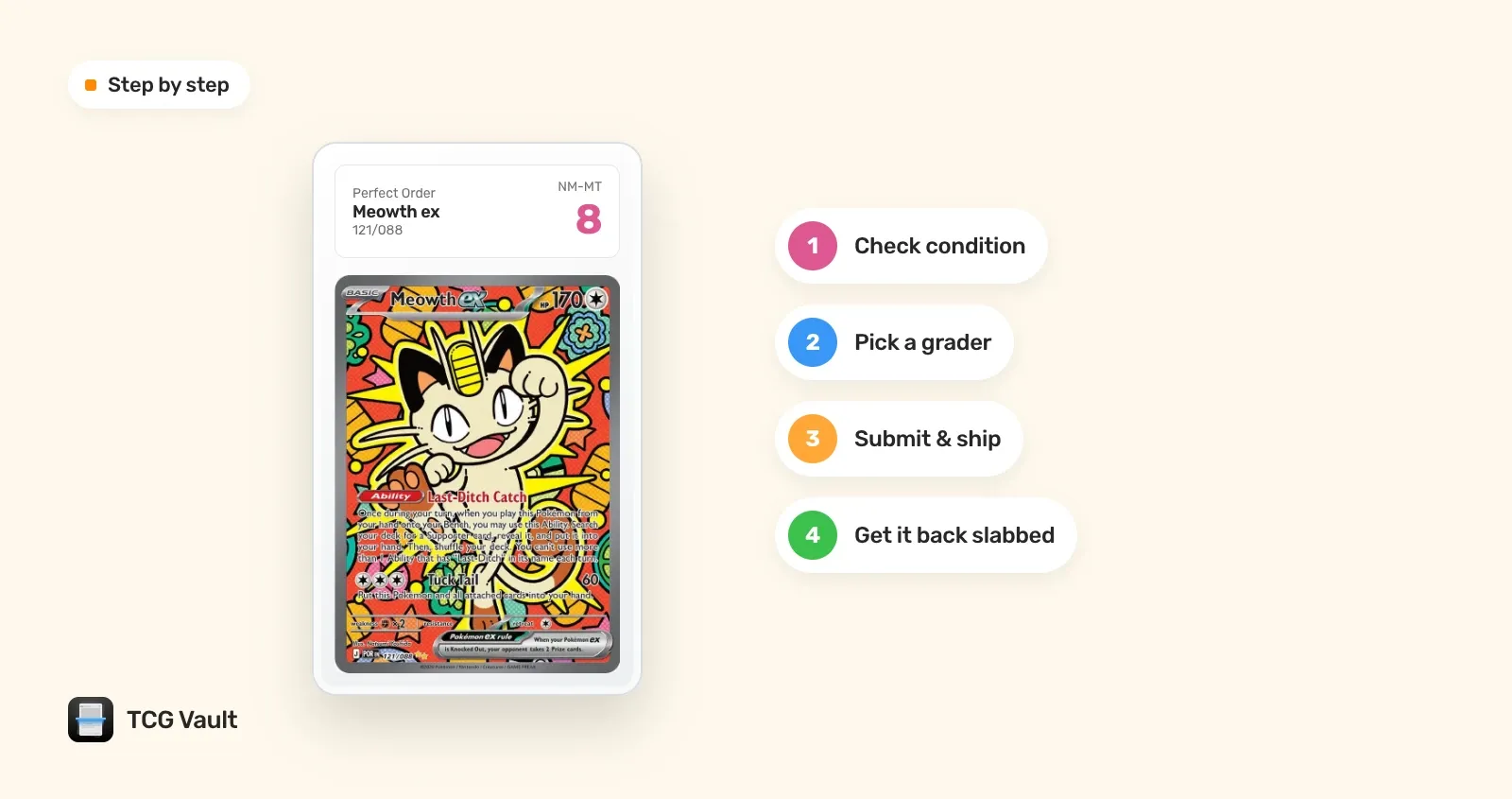
How to Grade Pokémon Cards: A Step-by-Step Guide (2026)
How to get Pokémon cards graded: choose PSA, CGC, Beckett or TAG, check condition, pick a tier by value, then pack and ship. Prices as of September 2026.
-
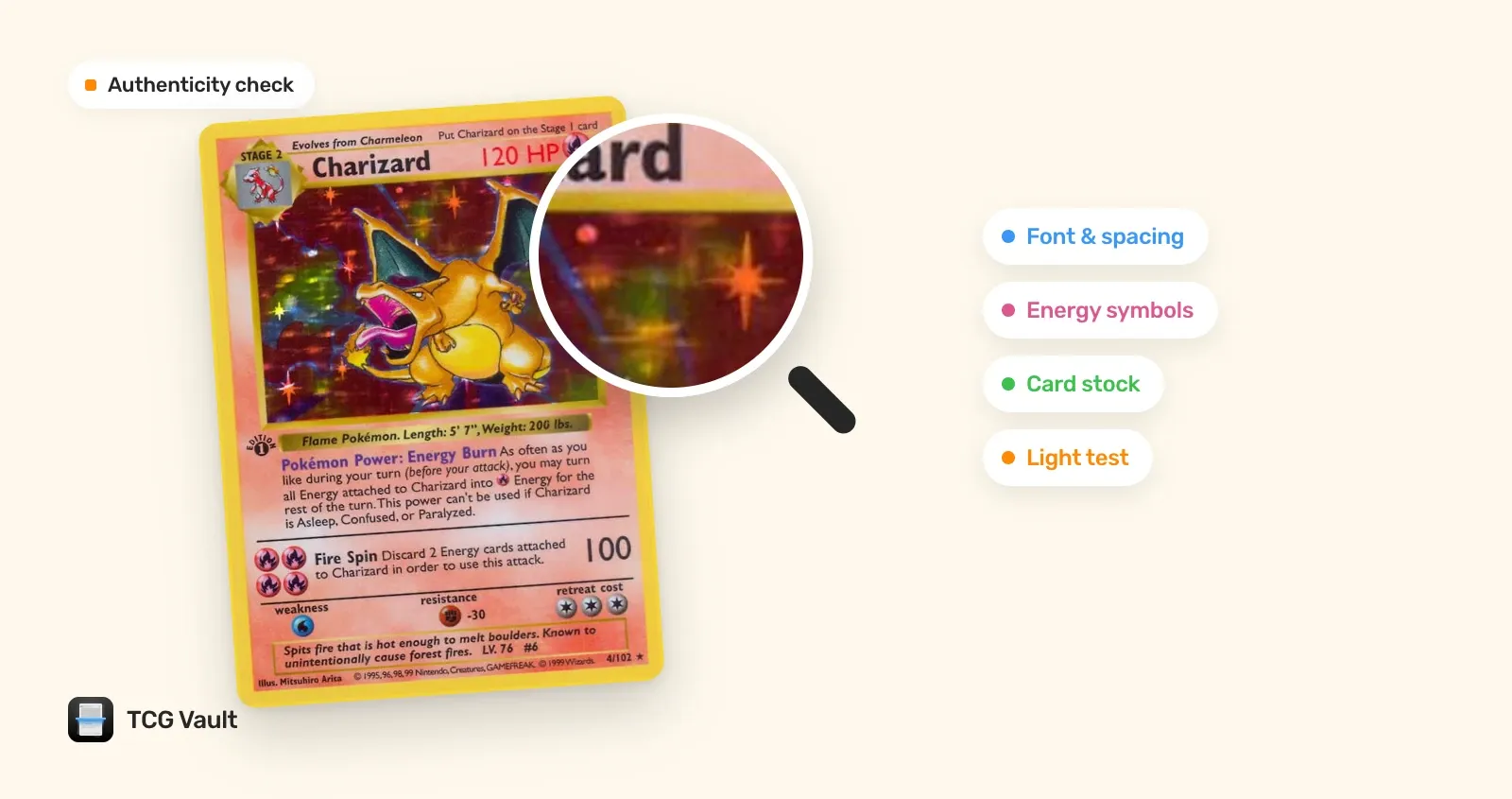
How to Tell If Pokémon Cards Are Fake: 10 Checks That Work
How to tell if Pokémon cards are fake: check the text, energy symbols, card back, holo, feel, size and set number, then the light test. Checklist inside.
Collectors rate us 4.6


See what your cards are really worth.
Scan a card with your iPhone and TCG Vault shows its market price in seconds — then keeps your whole collection’s value up to date.
 Download on iOS