 Free download, track your collection

How to Tell If Pokémon Cards Are Fake: 10 Checks That Work
By TCG Vault Team · · 7 min read
Written by the team that builds TCG Vault — how we research these guides.
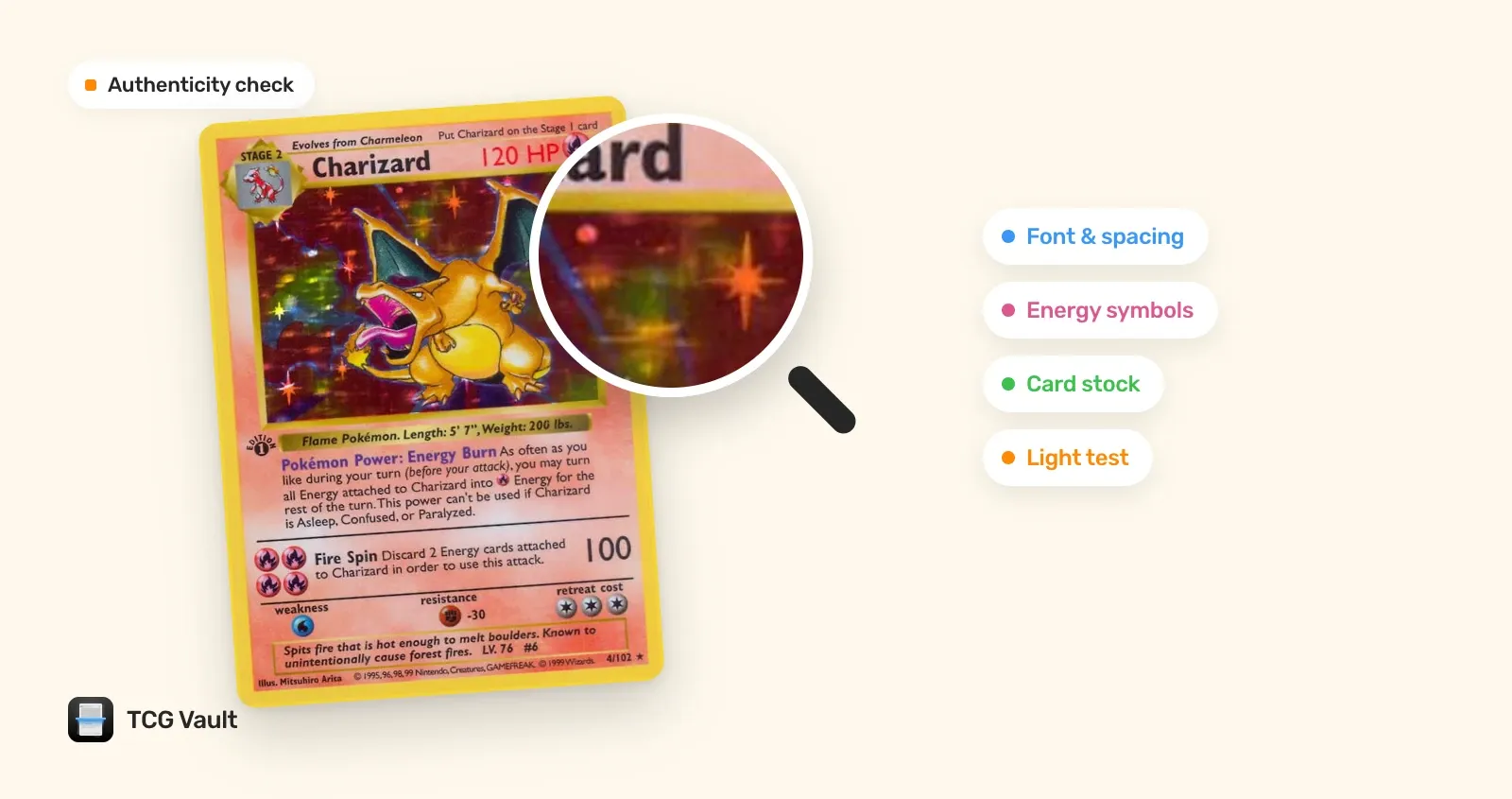
Knowing how to tell if Pokémon cards are fake matters more than ever, because the cards worth faking are worth a lot. A Special Illustration Rare of a popular Pokémon can sell for hundreds of dollars (the Umbreon ex from Prismatic Evolutions was at $1,410.28 on TCGplayer on September 19, 2026), and those are exactly the cards counterfeiters have a reason to copy.
The good news: many fakes are easy to catch once you know where to look. This guide collects the checks recommended by collector resources such as JustInBasil’s Pokémon TCG guide, CardMavin and TCGVerdict, and explains which ones you can trust.
How to tell if Pokémon cards are fake: compare first
The single best method is comparison. Put the card next to one you know is real, ideally from the same set or at least the same era, and look at them side by side. Differences that are invisible on their own jump out in a direct comparison.
Don’t rely on a single tell. A genuine card can have a factory flaw, and a good fake can pass one or two tests. What gives a fake away is a pattern: several small things that are each a little off.
The fake Pokémon card checklist
| Check | On a real card | Common sign of a fake |
|---|---|---|
| 1. Spelling and accents | “Pokémon” spelled with the é everywhere | Typos, swapped letters, missing accent |
| 2. Fonts and spacing | Even, consistent lettering | Wrong fonts, oversized or uneven letter spacing |
| 3. Energy symbols | Clean, correctly sized, aligned | Misaligned, misshapen, wrong size or missing |
| 4. HP, attacks, evolution | Values match the real card | Changed HP or damage, wrong type or evolution |
| 5. Card back | Deep blue with detailed shading in the swirl | Lighter, washed-out, sometimes purplish border |
| 6. Print quality | Sharp art, true colors | Overly dark, muted or purplish blues, fabric-like pattern |
| 7. Holo and texture | The set’s own holo pattern and texture | Flat shine, wrong pattern or no texture |
| 8. Feel | Firm, smooth card stock | Papery or plasticky |
| 9. Size and cut | Standard 2.5 × 3.5 inches | Slightly smaller, uneven or perforated edges |
| 10. Set symbol and number | A number that exists in that set | A number, rarity or set symbol that doesn’t match |
Expect a fake to fail several of these at once. If a card fails only one, look again next to a known genuine card before you decide.
How to spot a fake by the text and fonts
Text is often where cheap fakes fall apart. JustInBasil notes that misspellings are common, “including transpositions of neighboring letters and using similar letters in place of one another”. Read the card name, attack names and the Pokédex text line by line.
The accent is a quick tell. Genuine cards spell Pokémon with an é, and fakes often drop it “in various places on the card”. Check every instance, not just the logo.
Then look at the lettering itself. On fakes, letter spacing is often too wide or inconsistent, and the font may be subtly different from the real one. Side by side with a genuine card, this is surprisingly easy to see.
Check the energy symbols, HP and attacks
Energy symbols are small, precise shapes, and counterfeiters get them wrong. They’re “often misaligned, misshapen, incorrectly sized, or missing completely”, according to JustInBasil.
Game details are another giveaway. Fakes sometimes change a Pokémon’s HP or attack damage, give it the wrong type, or have it evolve from the wrong Pokémon. And one detail is conclusive: if a card shows rock-paper-scissors hand gestures, JustInBasil calls it “a guaranteed fake”.
When in doubt, look up the real card and compare every number.
What does the back of a fake Pokémon card look like?
The back is a reliable place to check, because every card shares the same design and you have plenty of real ones to compare. On fakes, the blue border tends to look lighter or slightly purple, and the colors look washed out, “as if not quite enough ink was applied.” CardMavin adds that genuine backs show more variation in the shading of the blue swirl, while fakes look flatter and blurrier.
Compare the back of a suspect card with any common from your own collection. You’ll rarely need anything more.
Do fake Pokémon cards have real holo and texture?
Usually not convincingly. Fakes “do a very poor job of mimicking the special holo and texture of the chase cards”, JustInBasil says. Tilt the card under a lamp next to a genuine card from the same set. CardMavin notes that when fakes attempt a holo effect, it often won’t shine and shimmer the way a real one does.
Many modern chase cards also have an etched, textured surface you can feel with a fingertip. If the real card is textured and the one in your hand is perfectly smooth, that’s a red flag.
Feel matters on ordinary cards too. Fakes often feel “especially papery or a bit plasticy because of the low-quality materials used.”
Does the light test work on fake Pokémon cards?
The light test is quick and doesn’t harm the card. Real cards are a sandwich of paper layers around a thin dark core, which blocks most light.
To do it properly, TCGVerdict recommends a dim room, a phone flashlight pressed flat against the back of the card and, most importantly, a known genuine card from a similar era to compare against. A real card “stays fairly opaque, with a dim, even glow at most”. A typical counterfeit has no dark core and “lights up like a lampshade”.
Know its limits, though. Better counterfeits now include a dark layer and pass the test, real cards vary between eras and print runs, and holo and full-art cards let light through differently. Treat the light test as a first screen, never as proof.
Is the card real? Check the set symbol and number
A fake can copy a card that never existed. Every card shows which set it belongs to (a set symbol, or on recent cards a short set code such as PRE) and a collector number such as 124/088. The second number is the set’s printed total; secret rares carry numbers above it. In Perfect Order, for example, the printed total is 088 and the highest card in our database is 124/088, so a “150/088” doesn’t exist.
This is where a scanner helps. Scan the card with TCG Vault and check that the name, set, number and rarity it returns match what’s printed. If they don’t line up, or the name and number belong to different cards, you’ve found a problem. For a quick lookup without the app, use our Pokémon card value checker.
The rip test: only for cards you’d throw away
Tearing a card shows its cross-section. A real card “is a sandwich of layers—with an opaque middle layer being dark grey or black”. Many fakes are a single piece of stock with no dark layer.
It’s the most direct check there is, but it destroys the card, so only use it on a duplicate from a suspect batch, never on the card you’re trying to verify.
How to avoid buying fake Pokémon cards
- Buy sealed product from official stores and retailers you know.
- Buy valuable singles from established sellers, and read their feedback.
- Use buyer protection. On eBay, cards selling for $200 or more qualify for the Authenticity Guarantee, where PSA inspects the card before it ships to you, at no extra cost.
- Be suspicious of prices far below market. Check the card’s current price first. Our list of the most expensive Pokémon cards shows which cards are worth faking.
- Buy graded for big-ticket cards. A card in a PSA or CGC holder has already been authenticated, and you can look up its certification number on the grader’s website. Our guide to the PSA grading scale explains what the label tells you.
Five minutes of checking before you pay is the cheapest insurance in the hobby.
Frequently asked questions
Are fake Pokémon cards worth anything?

Not as collectibles. Grading companies won't encapsulate them: PSA returns a card it believes is counterfeit without a grade, under the code N4 (questionable authenticity), and still charges the grading fee.
Can a card scanner app detect fake Pokémon cards?
No. TCG Vault identifies a card by reading its text and matching it to a database, so a well-made fake with correct text scans like the real card. Use the scan to confirm what the genuine card should be, then do the physical checks.
Are there fake Pokémon booster packs?
Yes. Counterfeit Pokémon products are sold too, often in packaging that doesn't closely copy the real thing. Compare any box or wrapper with official product photos, and buy sealed product from stores you trust.
Is a misprinted card a fake?
Not necessarily. Genuine cards can leave the factory miscut, with print defects or with faded or blurry text, and TCGplayer has condition rules for those errors. Judge the card on everything else before deciding.
What should I do if I bought a fake card?
Contact the seller first, then open a claim through the marketplace or payment service you used. Keep the card, the packaging and photos as evidence.
Keep reading
-
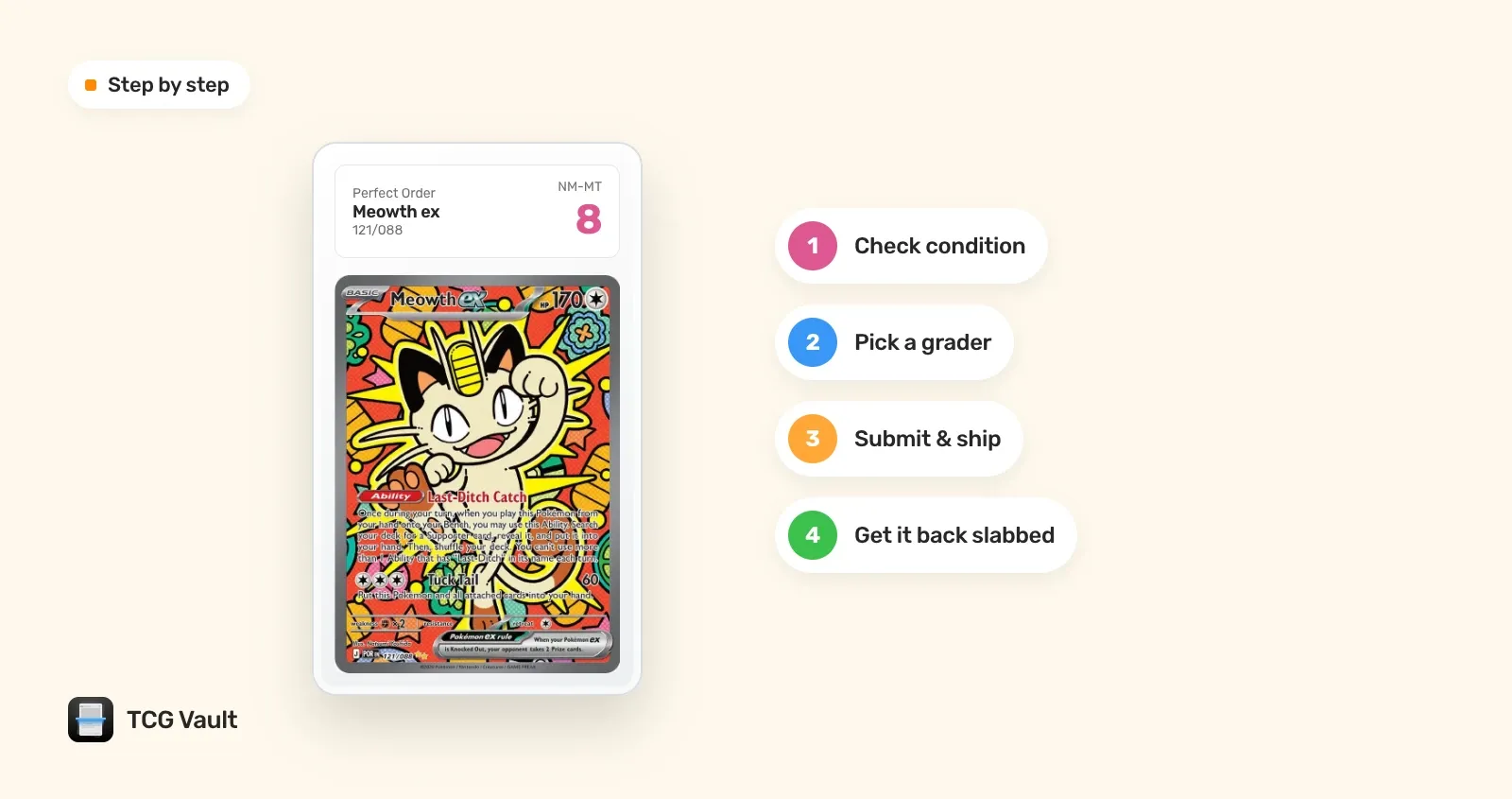
How to Grade Pokémon Cards: A Step-by-Step Guide (2026)
How to get Pokémon cards graded: choose PSA, CGC, Beckett or TAG, check condition, pick a tier by value, then pack and ship. Prices as of September 2026.
-
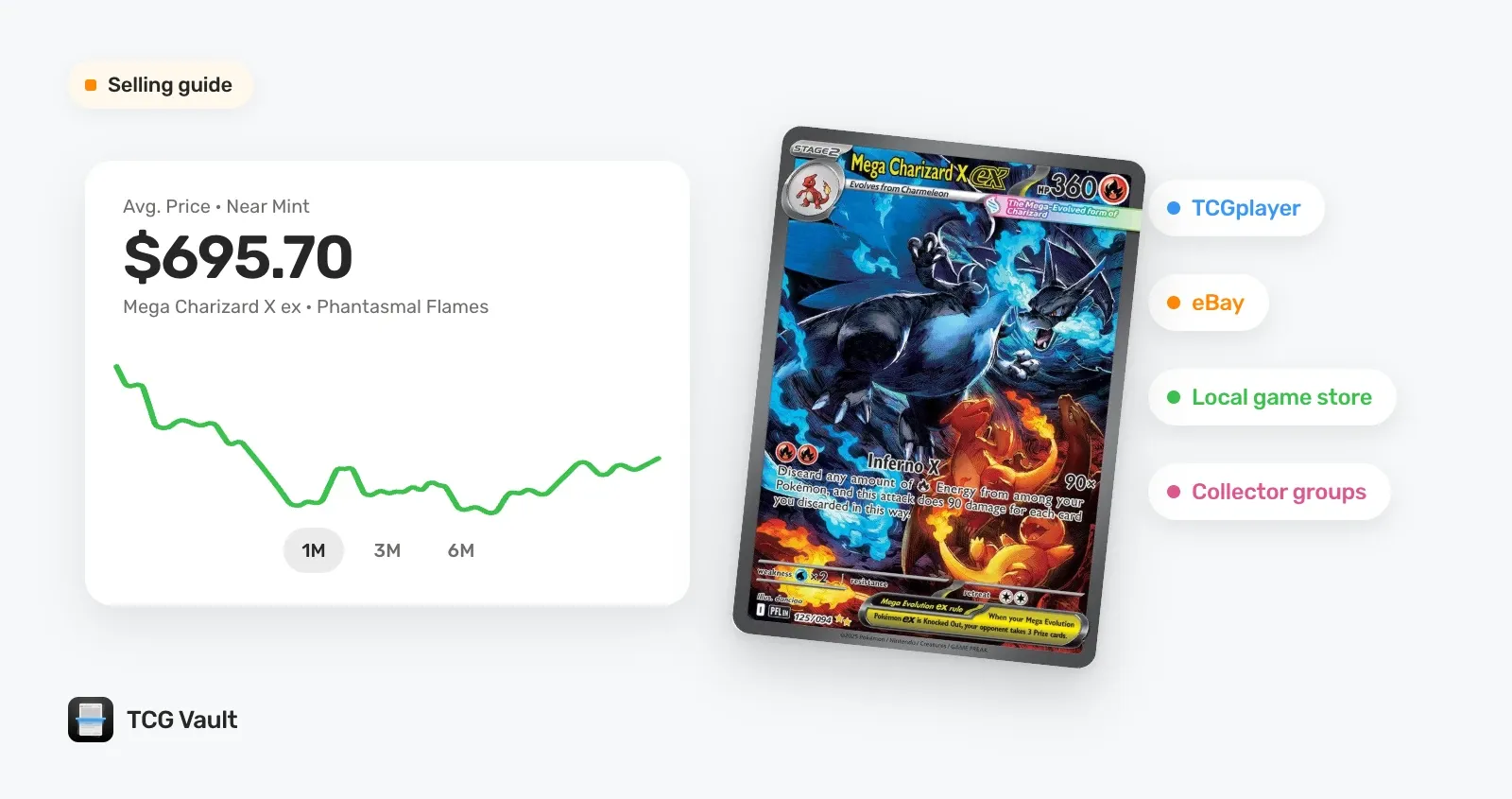
How to Sell Pokémon Cards: Where to Sell and What It Costs
Where to sell Pokémon cards: TCGplayer, eBay, Whatnot, Facebook groups, local stores and card shows, with each option's fees as of September 2026.
Collectors rate us 4.6


See what your cards are really worth.
Scan a card with your iPhone and TCG Vault shows its market price in seconds — then keeps your whole collection’s value up to date.
 Download on iOS