 Free download, track your collection

How to Sell Pokémon Cards: Where to Sell and What It Costs
By TCG Vault Team · · 7 min read
Written by the team that builds TCG Vault — how we research these guides.
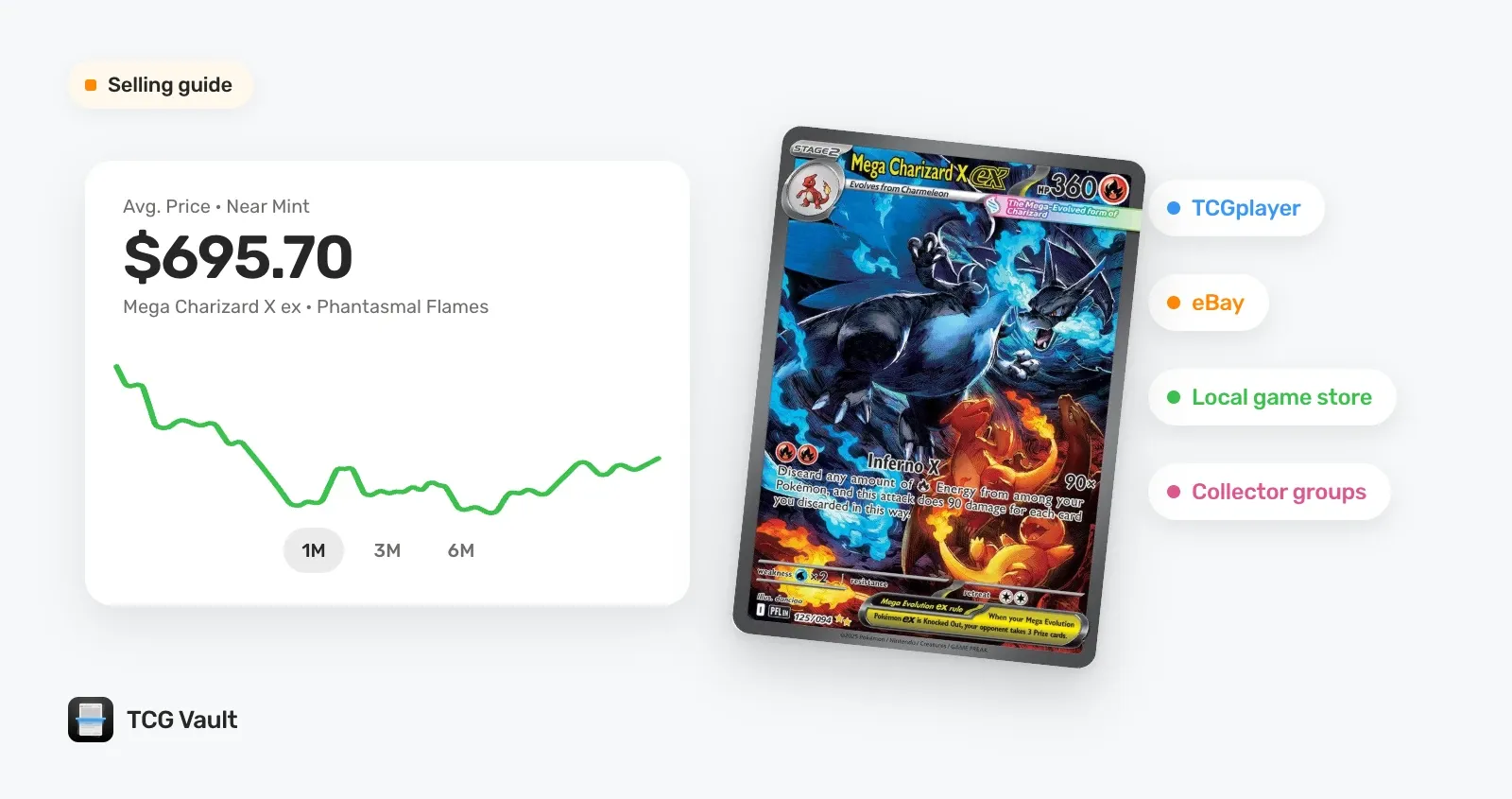
Learning how to sell Pokémon cards is mostly about matching each card to the right place. A $2 reverse holo, a $150 Special Illustration Rare and a shoebox of commons each have a different best buyer, and the wrong choice can cost you more in fees or low offers than the card is worth.
Below are your options, what each one charges and when to use it. All fees come from the platforms’ own fee pages, checked in September 2026. Fees change, so check again before a big sale.
Where can I sell my Pokémon cards?
These are the main places collectors sell, from online marketplaces to the local store:
| Where | What it costs (Sept 2026) | Best for | Watch out for |
|---|---|---|---|
| TCGplayer | 10.75% commission (capped at $75 per card) plus 2.5% + $0.30 per order | Singles of almost any value | New sellers start at Level 1: up to 100 cards listed, $1,000 in total, $500 per card |
| eBay | 13.25% of the total sale up to $7,500, plus $0.30 or $0.40 per order | High-value singles, graded cards, lots | The fee is charged on shipping and sales tax too |
| Whatnot | 8% of the item price plus 2.9% + $0.30 of the order total | Live auctions and regular sellers | Works best once you have an audience |
| Facebook groups and forums | No platform fee; PayPal Goods and Services charges 2.99% | Selling straight to collectors | You handle trust, payment and disputes yourself |
| Local game store | No fee, but the offer is below market | Fast cash, trade-in credit, bulk | Lowest price per card |
| Card shows | No fee to sell to a vendor | Selling good cards in person, quickly | Vendors buy below market so they can resell |
Online marketplaces put your card in front of buyers everywhere. The in-person options trade some of the price for speed and simplicity.
How much do you keep after fees?
Percentages are easier to compare in dollars. Here’s what each option leaves you from a single $100 card, before shipping and sales tax:
| Where | Fees on a $100 card | You keep |
|---|---|---|
| TCGplayer (Level 1–4 seller) | $10.75 commission + $2.80 transaction fee = $13.55 | $86.45 |
| eBay (no Store subscription) | $13.25 final value fee + $0.40 per-order fee = $13.65 | $86.35 |
| Whatnot | $8.00 commission + $3.20 processing = $11.20 | $88.80 |
| Private sale paid by PayPal Goods and Services | $2.99 | $97.01 |
| Local store or card show | $0 | Whatever they offer, usually below market |
Two details change the math in practice. TCGplayer’s transaction fee, eBay’s final value fee and Whatnot’s processing fee are all charged on the order total including shipping and tax, so real fees run a little higher than the table. And a private sale’s low fee comes with the extra work and risk of finding a buyer, collecting payment and handling any dispute yourself.
How to sell Pokémon cards, step by step
1. Separate the valuable cards from bulk
Most cards aren’t worth listing one by one. In Scarlet & Violet and Mega Evolution sets, the median plain common or uncommon sells for $0.13, and 78.7% of card versions go for under $1. Pull out full arts, gold cards, illustration rares, older holos and anything with a stamp, and set the rest aside. Our guide to what Pokémon cards are worth money shows which ones to look for.
2. Price each card from recent sales
Asking prices can be anything; sold prices tell you what buyers actually pay. TCGplayer’s market price is calculated from recent completed sales on its platform, which makes it a sound starting point. Scan the card with TCG Vault to see it in seconds, or look it up in our Pokémon card value checker. For cards worth $100 or more, compare several recent sales before you set a price.
3. Grade the condition honestly
Buyers price by condition, and so do returns. TCGplayer’s scale runs Near Mint, Lightly Played, Moderately Played, Heavily Played and Damaged. If you’re unsure between two conditions, list the lower one: a pleasantly surprised buyer leaves good feedback, an unhappy one opens a dispute.
4. Choose where to sell it
Match the card’s value to the venue:
- Under $1: sell as bulk to a local store or in a lot.
- $1 to about $100: TCGplayer is built for singles, and buyers search it by set and number.
- $100 and up: TCGplayer or eBay. On eBay, raw or graded cards selling for $200 or more qualify for eBay’s Authenticity Guarantee, where PSA inspects the card before it goes to the buyer, at no cost to either side.
- Graded cards: eBay, where buyers can shop by grading company and grade.
- Cash today: a local store or a card show vendor.
5. Write a listing buyers trust
Use the exact card name, set, collector number and version (holo, reverse holo, 1st Edition). Photograph the front and back, and show any flaw you mention. A clear listing helps buyers trust you and heads off “not as described” claims.
6. Pack and ship it safely
TCGplayer’s own shipping guide is a good standard for any platform: put the card in a soft sleeve, then a top loader, then a resealable team bag, and ship it in a bubble mailer. On TCGplayer, orders over $49.99 must have tracking and orders over $250 need signature confirmation, and TCGplayer recommends tracking on anything over $20.
Where can you sell Pokémon cards for the most money?
For a single card, you’ll usually net the most by selling it online at market price, even after fees. A local store has to buy below market so it can resell at a profit, which is why its offer is lower. The exception is cheap cards: on a $1 single, the fixed per-order fee and the cost of a sleeve, top loader and envelope eat most of the sale, so low-value cards are better sold in bulk or bundled.
Grading can change the math for valuable cards. If a card is valuable and in top condition, a grade can raise the price a buyer will pay. Whether it’s worth it depends on the fee and the likely grade; our guide on how to grade Pokémon cards walks through both.
Selling to a local game store or at a card show
In-person selling is the fastest way to turn cards into money, and there’s no platform fee. The trade-off is price: a store or vendor needs a margin to resell, so their offer will be below the market price you see online.
A few habits get you better offers:
- Look up prices before you go. Walk in knowing what each card is worth, so you can judge an offer in seconds.
- Ask about store credit as well as cash. If the credit offer is higher and you’ll spend the money on cards anyway, credit can be the better deal.
- Bring cards sorted and sleeved. Valuable singles in top loaders, bulk sorted by type. Vendors price faster and more confidently when they don’t have to dig.
- Shop the offer around. At a card show, several vendors are a few tables apart. Get more than one number for anything valuable.
Can you sell bulk Pokémon cards?
Yes, but set your expectations. Bulk is sold by the stack, not by the card, and offers reflect that. Sorting it by type first (commons and uncommons, reverse holos, holo rares, ex cards) makes it easier to get a fair offer, since the shinier piles are worth more. Two of the cheapest categories in our database: Basic Energy cards (a median of $0.20 for the Scarlet & Violet Energy printings) and Pokémon TCG Live code cards (a median of about $0.11).
Before you sell a box of bulk, flip through it for anything shiny, textured or stamped, and scan the cards you’re unsure about with TCG Vault. It’s the easiest way to catch the one card in the pile that shouldn’t be there.
Selling mistakes that cost you money
- Pricing from listings instead of sales. Overpriced cards sit unsold; underpriced ones sell fast and you never find out what you gave away.
- Forgetting that fees apply to shipping. Factor fees into what you charge for postage.
- Shipping untracked. Without tracking, a “never arrived” claim is hard to win; on TCGplayer, sellers who skip the required tracking give up the ability to win those disputes.
- Selling a collection without checking it. Scan it first; one missed chase card can be worth more than the rest of the lot.
- Taking risky payments in private sales. Use a payment method with a clear dispute process, and don’t ship until the money has cleared.
Sell the valuable cards one at a time, sell the bulk in bulk, and you’ll get close to what your collection is really worth.
Frequently asked questions
What's the best app to sell Pokémon cards?

For singles, the main online marketplaces are TCGplayer and eBay; Whatnot is built around live selling. TCG Vault doesn't sell cards, but it shows each card's market price and its premium plan links straight to the card on TCGplayer.
Is it better to sell Pokémon cards raw or graded?
Graded makes sense for valuable cards in top condition, because buyers pay for certainty. For cards worth less than the grading fee, sell them raw.
How do I sell a whole Pokémon card collection at once?
Local game stores and card show vendors will make an offer on a whole lot. Pull out and price the valuable cards first, because bulk offers are based on volume, not on the few cards that carry the value.
How do I avoid scams when selling Pokémon cards online?
Sell through a marketplace that handles the payment, ship only to the address on the order, and use tracking. In private sales, never ship before the payment has cleared.
How do I know what price to ask?
Use recent sales, not asking prices. TCGplayer's market price is built from completed sales, and TCG Vault shows it when you scan a card.
Keep reading
-
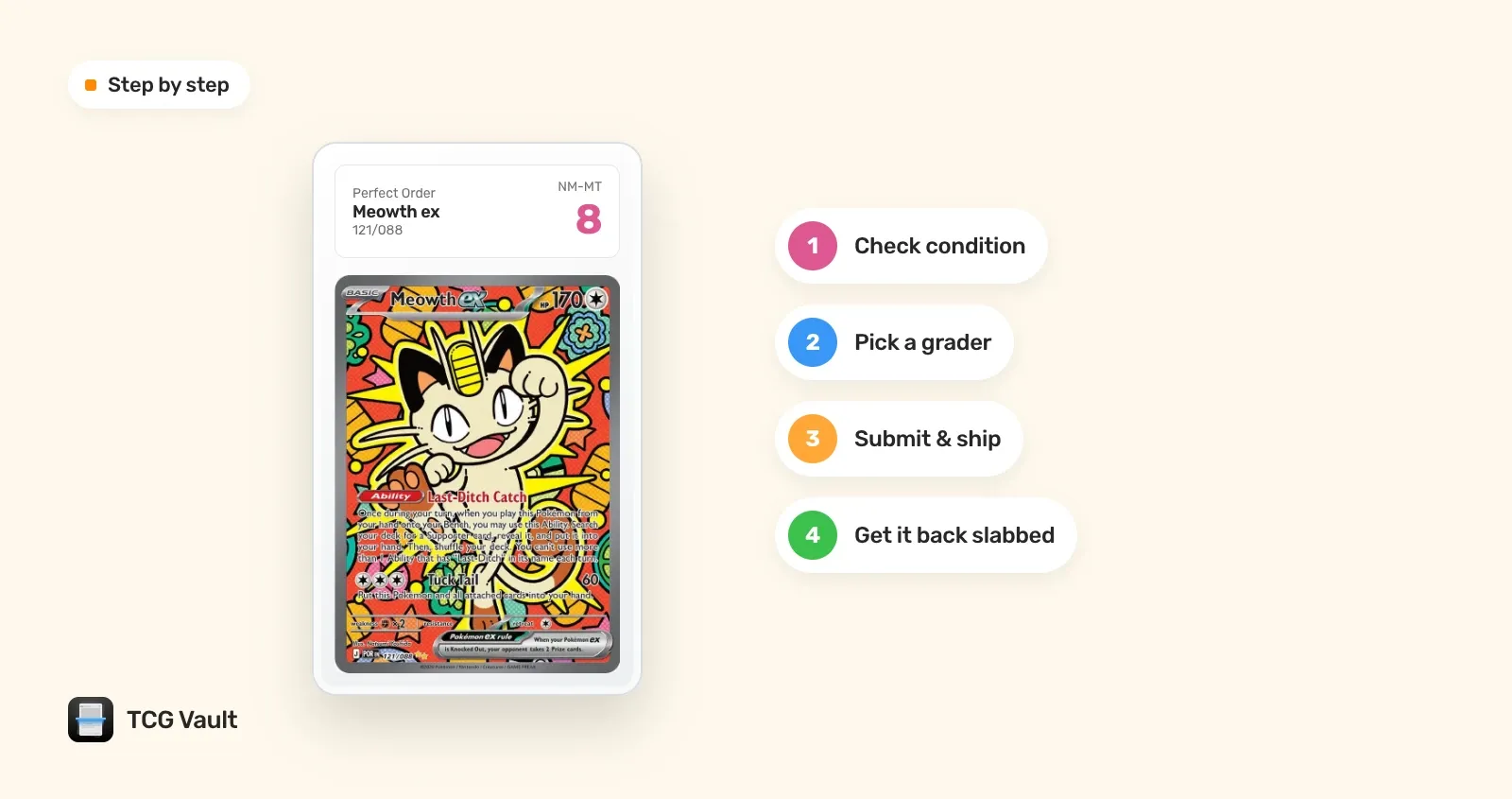
How to Grade Pokémon Cards: A Step-by-Step Guide (2026)
How to get Pokémon cards graded: choose PSA, CGC, Beckett or TAG, check condition, pick a tier by value, then pack and ship. Prices as of September 2026.
-
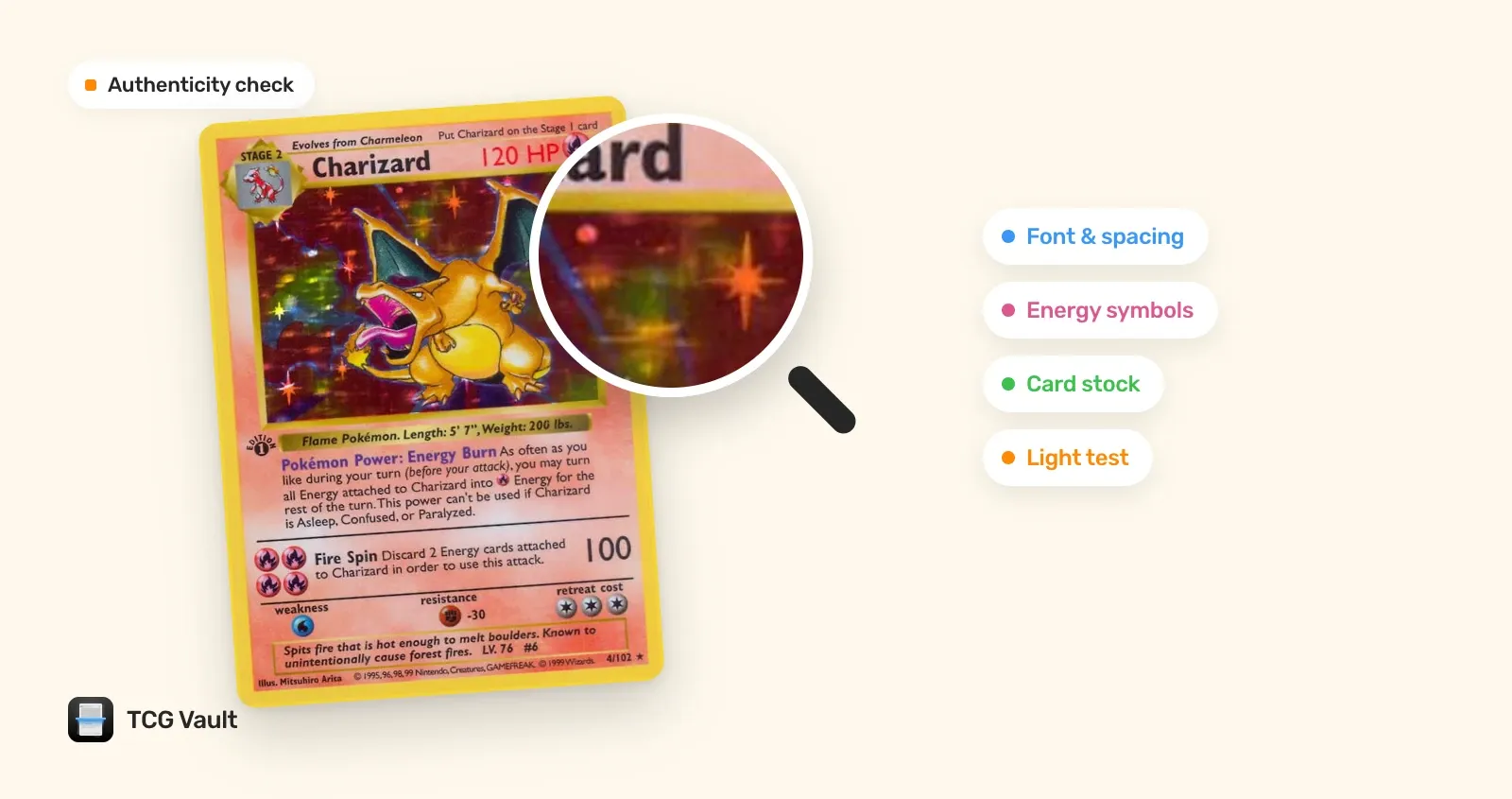
How to Tell If Pokémon Cards Are Fake: 10 Checks That Work
How to tell if Pokémon cards are fake: check the text, energy symbols, card back, holo, feel, size and set number, then the light test. Checklist inside.
Collectors rate us 4.6


See what your cards are really worth.
Scan a card with your iPhone and TCG Vault shows its market price in seconds — then keeps your whole collection’s value up to date.
 Download on iOS